
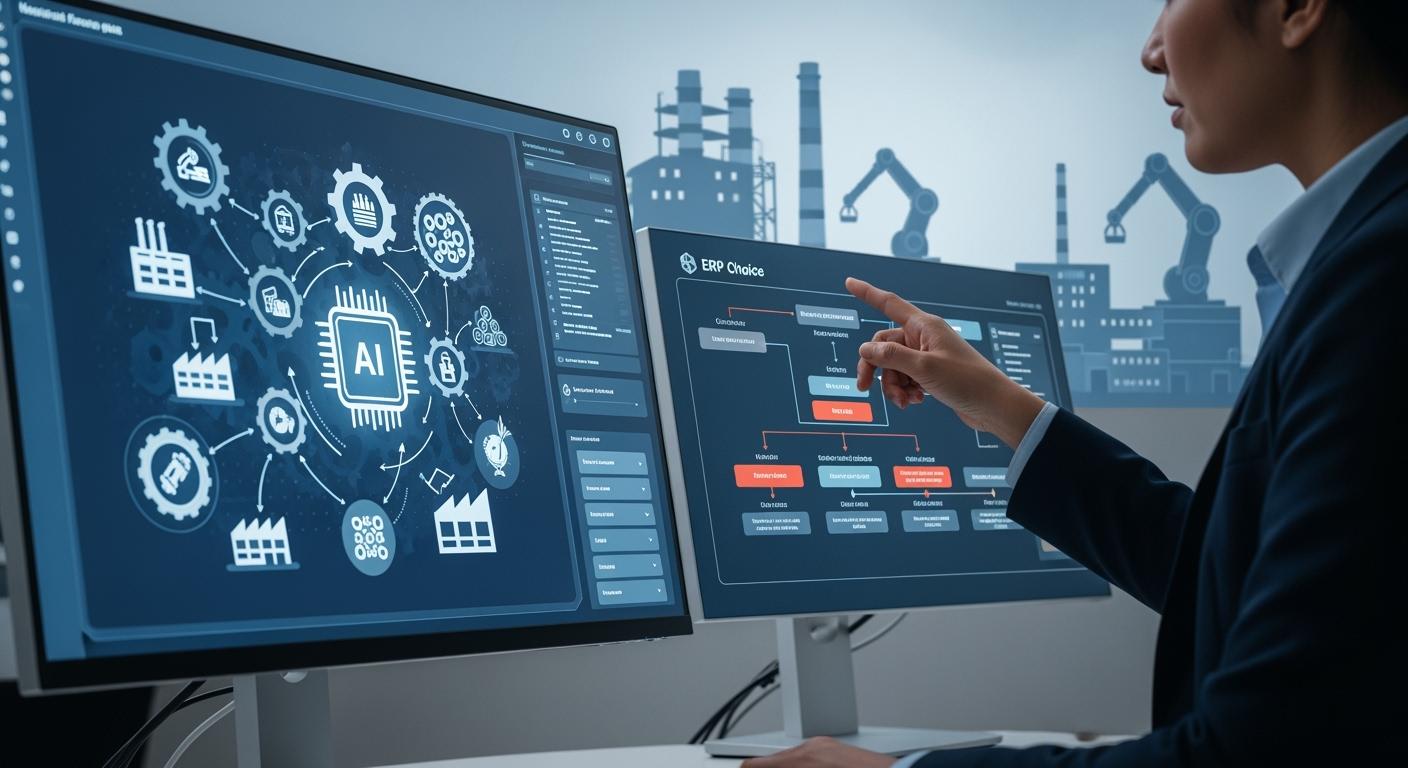
You can choose the right AI ERP platform for manufacturing by matching platform features to your specific needs. Focus on scalability, integration, and the benefits of AI. Recent industry reports show that AI transforms erp systems, making them intelligent and responsive. This shift boosts your manufacturing competitiveness and efficiency. The table below highlights how AI adoption impacts manufacturing:
| Description | Impact on Manufacturing Competitiveness |
|---|---|
| AI transforms erp into systems that predict operations | Improves efficiency and decision-making |
| Strategic AI adoption gives an advantage | Helps you gain a competitive edge |
| Readiness in people and processes ensures success | Maximizes benefits and long-term success |
| AI is now a priority in erp for manufacturing enterprises | Enhances operational efficiency and competitiveness |
| Competitors using vertical AI compress cycle times | Urgency for manufacturers to adopt AI ERP Platforms to stay competitive |
Why AI in Manufacturing ERP Matters
AI-Driven Automation and Efficiency
You can transform your manufacturing operations with AI-driven automation in manufacturing erp software. AI helps automate repetitive tasks, such as data entry and scheduling, which saves time and reduces errors. You gain better control over inventory and production planning erp systems. AI learns from your data and adapts to changes in supply or demand. This means your erp can automatically reschedule production if a supplier delay occurs. Many companies now use ai erp platforms to optimize logistics, cut fuel costs, and improve delivery performance. You also see improved maintenance and operations, as AI schedules repairs before breakdowns happen. Automated financial reconciliation and streamlined procurement boost efficiency across your enterprise resource planning solutions.
- AI enhances demand forecasting and inventory management.
- It automates processes, improving operational efficiency.
- AI-driven logistics shift you from reactive to proactive supply chain management software.
Predictive Analytics in Manufacturing
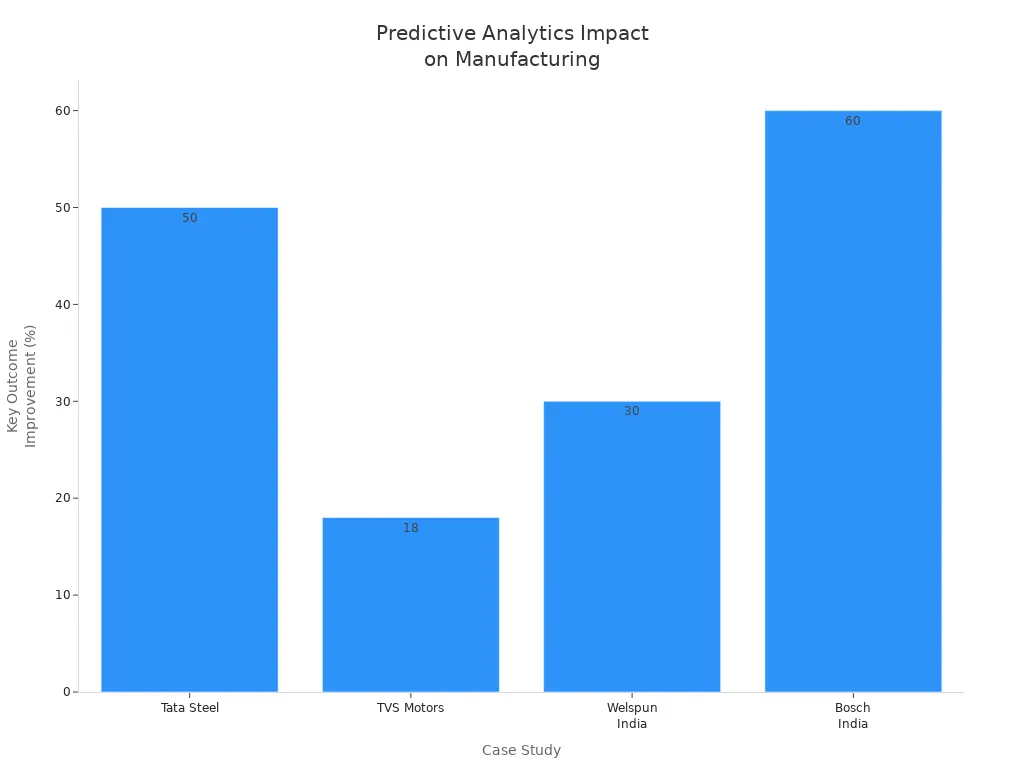
Predictive analytics in manufacturing erp software uses machine learning to analyze sensor data and past trends. You can forecast equipment failures and demand changes before they happen. This reduces downtime and maintenance costs. For example, manufacturers using predictive maintenance systems have seen machine downtime drop by up to 50%. You also improve forecast accuracy, which helps you align production with market needs. The table below shows real-world results:
| Company | Outcome |
|---|---|
| Tata Steel | 50% less unplanned downtime, big cost savings |
| TVS Motors | 18% better first-pass yield |
| Welspun India | 30% fewer quality complaints |
| Bosch India | 10% higher line efficiency |
Smarter Decision-Making
AI in manufacturing erp software gives you real-time insights. You can adjust safety stock based on demand swings or supply chain disruptions. AI-powered erp systems process data as events happen, so you spot problems instantly. This leads to faster, better decisions. You can identify material substitutions and sourcing alternatives, keeping production on track. With seamless integration and cloud erp systems, you get a clear view of your operations. AI helps you improve supply chain management software, optimize inventory, and boost efficiency.
Key Criteria for Manufacturing ERP Software
Industry-Specific Features
You need manufacturing erp software that fits your industry. Look for features that help you manage production, inventory, and supply chain management software. The best manufacturing erp includes:
- Predictive analytics and intelligent automation for better efficiency.
- Conversational AI interfaces that make erp easy to use.
- AI agents that handle business processes and boost customization.
These features help you improve production planning erp systems and keep your manufacturing operations running smoothly.
Integration and Scalability
Integration is key for manufacturing erp software. You want seamless integration with your current systems, machines, and cloud erp systems. The table below shows how leading platforms support integration and production planning erp systems:
| Feature/Application | Description |
|---|---|
| AI-Driven Insights | Real-time analytics for accounting, sales, and customer management. |
| IoT and AI Integration | Predictive maintenance and supply chain optimization. |
| Real-Time Production Monitoring | Visibility into production processes for better decisions. |
| IIoT/Smart Factory Integration | Connects with IoT devices, sensors, and robotics. |
| Shop Floor Control/Execution | Tracks shop floor operations and production output. |
| Manufacturing Data Collection | Automates data collection from machines and sensors. |
You also need manufacturing erp software that grows with your business. Scalability benchmarks include technical, functional, and operational scalability. Test how the software handles more orders and users. Check if you can add business units and share records easily.
AI Capabilities and Customization
AI erp platforms give you tools to automate tasks and improve efficiency. You get predictive analytics, machine learning, and natural language processing. Top manufacturing erp software lets you customize workflows and reports. You can use explainable AI for transparency and hyper automation for faster business processes. Cross-platform AI capabilities help you connect different erp modules and enterprise resource planning solutions.
User Experience and Support
You want manufacturing erp software with intuitive interfaces and strong support. Generative AI offers conversational interfaces, making erp easy for everyone. Automated data summarization and proactive recommendations help you make quick decisions. Personalized user experiences improve efficiency and help you manage inventory, production, and supply chain management software.
Cost and ROI
The cost of manufacturing erp software depends on your needs. For mid-sized manufacturing companies, the total investment can reach $535,000. This includes software licenses, implementation, data migration, training, and customization.
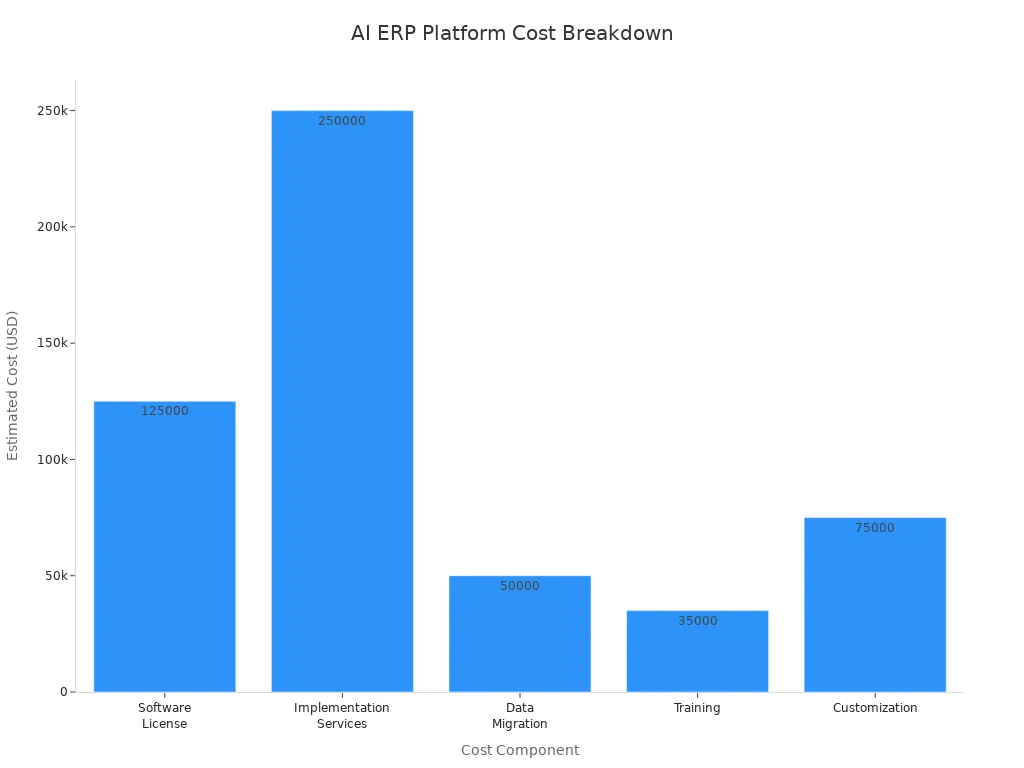
Many manufacturers report a 250% ROI within 18 months after deploying AI erp platforms. You can boost operational efficiency, reduce downtime, and improve inventory management with the right enterprise resource planning solutions.
Comparing Top AI ERP Platforms for Manufacturing
Overview of Leading AI ERP Platforms
You have many choices when you look for ai erp platforms for manufacturing. Some of the most popular options include SAP S/4HANA, Oracle NetSuite, Microsoft Dynamics 365, Acumatica, Infor CloudSuite, Epicor, Plex Systems, SAP Business One, Infor SyteLine, IFS.ai Cloud, Oracle Fusion Cloud ERP, and QuickBooks Desktop. These platforms help you manage your production, inventory, and supply chain management software. They also use ai to improve efficiency and decision-making.
The table below shows the market share and key features of some top erp platforms in manufacturing:
| ERP Platform | Market Share | Key Features |
|---|---|---|
| SAP S/4HANA | 27% | Global supply chain management, real-time data processing, strong ai tools |
| Oracle NetSuite | N/A | Cloud-native, all-in-one, financials, inventory management, ai automation |
| Odoo | 25% (by 2027) | Modular, open-source, app-based, good for small and medium manufacturers |
You can see that SAP S/4HANA and Odoo lead the market. NetSuite is also a strong choice for cloud erp systems.
Strengths and Weaknesses for Manufacturing
Each manufacturing erp software has its own strengths and weaknesses. You should look at ai features, integration, scalability, and how well the software fits your needs.
- Acumatica gives you machine-learning for expense classification, predictive inventory, and anomaly detection. It offers smart automation but has fewer built-in ai features than some others.
- NetSuite provides built-in ai for reporting, forecasting, process automation, and an ai assistant. It works well for many types of manufacturing.
- Microsoft Dynamics 365 lets you use text summarization, automated insights, and natural-language financial queries. It supports seamless integration with other Microsoft tools.
- SAP S/4HANA stands out with embedded machine learning, live material requirements planning (MRP), and predictive MRP for inventory management. It handles large data sets and complex supply chains.
- Oracle Fusion Cloud ERP gives you advanced financial tools and strong integration with other Oracle solutions. It works best for large enterprises but can be expensive and less user-friendly.
- Infor CloudSuite is made for manufacturing. It has an intuitive interface and industry-specific modules. Some users say it can be slow or crash at times.
- Epicor and Plex Systems help you with demand forecasting, production optimization, and smart automation. Many manufacturers face challenges with integration, especially if they use old legacy systems. Data security and compliance are also important concerns.
- SAP Business One, Infor SyteLine, IFS.ai Cloud, and QuickBooks Desktop offer solutions for smaller manufacturers or those with specific needs. They may not have as many ai features as the larger platforms.
Tip: When you choose manufacturing erp software, check if it supports seamless integration with your current systems and partners.
Feature Comparison Table
You can compare the main features of the top ai erp platforms for manufacturing in the table below:
| Feature | SAP S/4HANA | NetSuite | Microsoft Dynamics 365 | Acumatica | Infor CloudSuite | Epicor | Plex Systems |
|---|---|---|---|---|---|---|---|
| Predictive Analytics | Yes | Yes | Yes | No | Yes | Yes | Yes |
| Intelligent Process Automation | Yes | Yes | Yes | Yes | Yes | Yes | Yes |
| AI-Powered Chatbots | No | Yes | Yes | No | No | No | No |
| Smart Resource Optimization | Yes | Yes | Yes | Yes | Yes | Yes | Yes |
| Enhanced Security with AI | Yes | No | No | No | No | No | No |
| Industry-Specific Modules | Yes | Yes | Yes | Yes | Yes | Yes | Yes |
| Cloud ERP Systems | Yes | Yes | Yes | Yes | Yes | Yes | Yes |
This table helps you see which erp software matches your manufacturing needs. For example, if you want enhanced security with ai, SAP S/4HANA is a strong choice. If you need ai-powered chatbots, NetSuite and Microsoft Dynamics 365 stand out.
Case Studies and Success Stories
Many manufacturers have improved their operations by using ai erp platforms. Here are some real-world examples:
- Toyota used SAP S/4HANA to improve its global supply chain. The company now tracks logistics in real time and manages master data from one place. This change increased efficiency in Europe and set a model for other regions.
- Foxconn adopted SAP S/4HANA for electric vehicle manufacturing. The company saw a 20% improvement in resource use and fixed data quality and inventory problems.
- Epicor and Plex Systems helped manufacturers like Marmon Water and DMN-WESTINGHOUSE. These companies improved efficiency, reduced costs, and made better decisions with ai insights. They also saw gains in productivity and customer satisfaction.
- Infor SyteLine supports manufacturers who need strong production planning erp systems and industry-specific features.
Note: Manufacturers who switch to ai erp platforms often see better operational efficiency, faster production planning, and improved inventory management.
You can use these success stories to guide your search for the best manufacturing erp. When you choose the right enterprise resource planning solutions, you help your business grow and stay competitive.
Data Privacy, Compliance, and Implementation
Data Security in Manufacturing ERP Systems
You protect your manufacturing data by following strong security practices in your erp software. Regular system audits help you find weaknesses and fix compliance issues. You control user access so only the right people see sensitive information. Data encryption keeps your inventory and supply chain management software safe both when stored and sent. You update your software often to close security gaps. Employee training teaches your team about threats and safe habits. Strong passwords and multi-factor authentication make your system harder to break into. You back up your data regularly to recover quickly if something goes wrong. Security incident response planning prepares you for emergencies. Vendor management ensures your partners follow security rules. Security analytics give you real-time alerts about risks.
Regulatory Compliance
You meet industry rules by using erp software that supports compliance. Centralized data management gives you one source of truth for audits. Automated audit trails record every action for inspections. Real-time monitoring helps you spot problems before they become violations. Batch and lot tracking lets you trace inventory for recalls and reports. Quality control integration connects inspection schedules and test results with production planning. These features help you follow standards like ISO 9001 and GDPR.
Tip: Choose erp software that makes compliance easy and keeps your manufacturing business safe.
Implementation Strategies
You improve efficiency by using smart strategies when you deploy ai erp platforms. Start with a maturity and readiness assessment to check your data quality and find high-value use cases. Align ai projects with your business goals and focus on pain points. Begin with a small, high-impact project for quick wins. Pick software with pre-built connectors and strong governance for manufacturing needs. Use embedded ai features in your current software to reduce integration work. Build your system step by step, using each success to strengthen your data foundation.
Change Management
You manage change by treating erp implementation as a business transformation. Communication and alignment help your team accept new software. Executive sponsorship and operational leadership work together for success. Structured communication strategies keep everyone informed and reduce resistance. You support your team through training and clear goals. This approach helps your manufacturing company adapt and grow with new erp and ai tools.
Choosing the Best Manufacturing ERP
Aligning Needs with Platform Features
You can find the best manufacturing erp by matching your business needs to the features of each platform. Start by defining your objectives. Decide what you want to achieve, such as improving efficiency or reducing inventory errors. Assess your data and focus on data quality. Clean and organize your information so you can use it for ai-driven insights.
Begin your ai journey with a cloud-first strategy. Cloud erp systems help you scale and adapt quickly. Prioritize practical ai features that solve real manufacturing problems. Make your end users part of the adoption process. Ask for feedback and include them in training. Build trust by starting small and expanding as you see results.
- Land and expand the use of ai in your operations.
- Establish human-in-the-loop workflows to keep people involved.
- Encourage ai skills development among your team.
You can boost efficiency by using platforms that offer production planning and advanced scheduling. Look for real-time inventory and traceability features. Embedded quality management systems help you maintain high standards. User experience matters, so choose platforms with role-based dashboards that make tasks easier.
Tip: Match your manufacturing modes, such as Engineer-to-Order or Make-to-Stock, to the erp features you need.
Making a Confident Decision
You can make a confident decision by following a clear framework. Define your business objectives and success metrics before you select a platform. Clarify your manufacturing modes to shape your requirements. Establish a cross-functional selection committee with members from operations, quality, supply chain, finance, and IT.
Document and prioritize your top operational bottlenecks. Translate your goals into measurable KPIs. Use these KPIs to guide your selection process. Compare platforms based on how well they address your needs for efficiency, inventory management, and ai capabilities.
Create a table to track your requirements and how each platform meets them:
| Requirement | Platform A | Platform B | Platform C |
|---|---|---|---|
| Real-time inventory | Yes | Yes | No |
| Production planning | Yes | No | Yes |
| Quality management | Yes | Yes | Yes |
| User experience | Good | Excellent | Fair |
You can use this table to visualize your options and make the best choice for your manufacturing business.
You can choose the best AI ERP platform by following a clear process.
- AI helps with demand forecasting, predictive maintenance, and real-time defect checks.
- Good data and strong integration with your current systems lead to better results.
- Start with a plan, focus on data, and involve your team.
Use the steps and tables in this guide to make a smart choice for your manufacturing business. Reach out to experts if you need more help.
FAQ
What is an AI ERP platform?
You use an AI ERP platform to manage your manufacturing business. It combines artificial intelligence with enterprise resource planning. You get automation, predictive analytics, and smarter decision-making.
How does AI improve manufacturing ERP?
AI helps you automate tasks and predict problems. You see real-time data and get faster insights. You can reduce downtime and improve inventory management.
Can you integrate AI ERP with existing systems?
You can connect AI ERP platforms with your current systems. Most platforms offer pre-built connectors and APIs. You keep your data and workflows running smoothly.
Is AI ERP secure for manufacturing data?
You protect your data with strong security features. AI ERP platforms use encryption, access controls, and regular audits. You keep sensitive information safe.
How do you choose the best AI ERP for your business?
You start by listing your needs. You compare features, scalability, and AI tools. You test user experience and support. You check cost and ROI before making a decision.
See Also
Utilizing AI to Improve Production Forecasting Accuracy in 2024
Key Features That Differentiate WarpDriven ERP for Smart Management
Capacity Planning for Brands Enhanced by AI Technology
AI Solutions for Dynamic Safety Stock in Fashion Retail 2025