
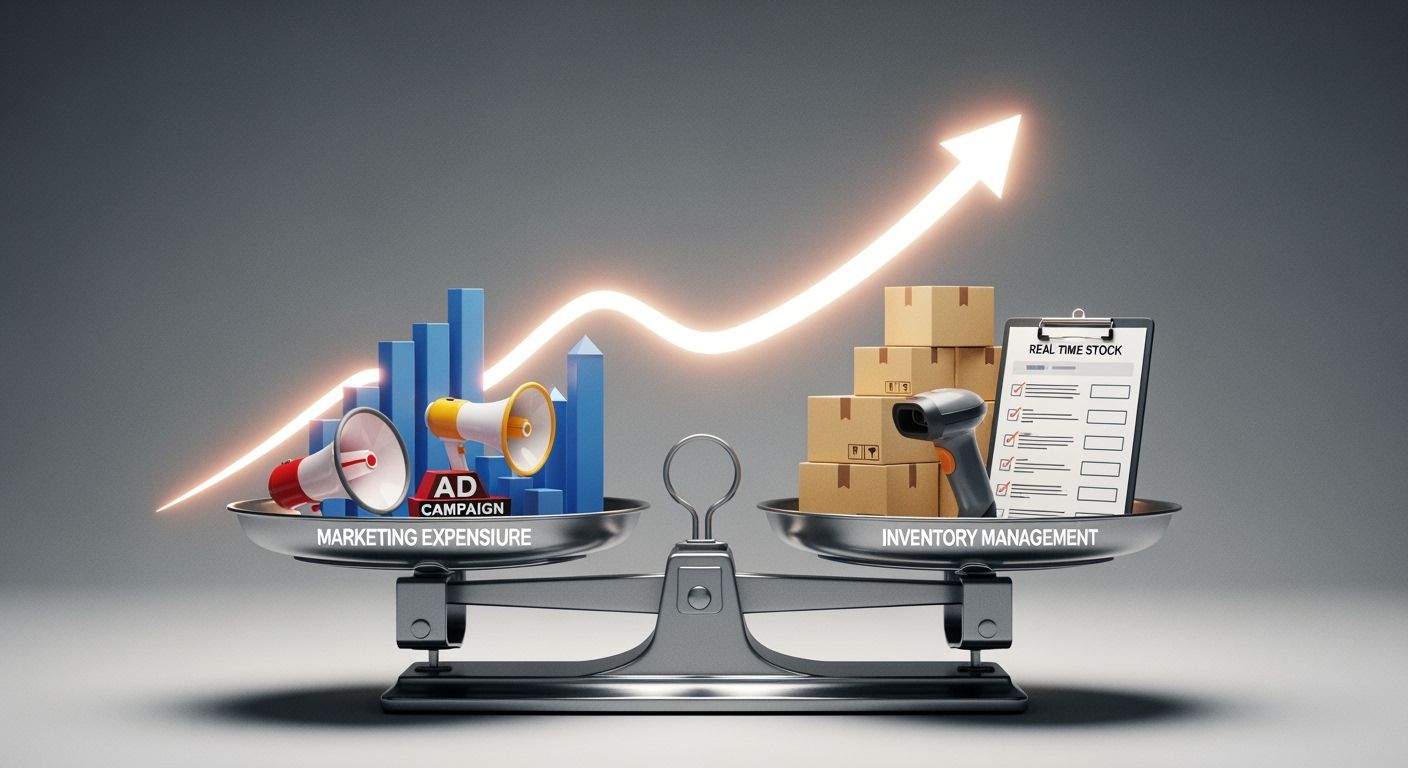
You waste valuable ad dollars when paid campaigns send eager buyers to sold-out product pages. Every click on an unavailable item inflates your customer acquisition cost and destroys profit margins.
Connecting performance marketing automation to your real-time inventory protects your bottom line instantly. Real-time inventory synchronization stops campaigns for out-of-stock items, prevents wasted spend, and improves cash flow.
Balancing marketing spend with actual stock levels optimizes your entire budget. Smart marketing budget optimization protects your return on investment and drives long-term customer lifetime value. This stock-aware optimization aligns marketing metrics directly with physical inventory to increase profit and retain happy shoppers.
Risks of Unaligned Marketing Spend and Inventory

Wasted Ad Capital on Out-of-Stock SKUs
When you run paid marketing without real-time stock visibility, you spend ad money on clicks that cannot convert. For consumer packaged goods brands, the customer acquisition cost typically ranges from $10 to $50 per customer. Promoting sold-out items creates an average wasted customer acquisition cost of $30 per customer. This mistake wastes your ad budget while reducing customer lifetime value.
Stockouts also kill active campaign performance. When product levels drop below 30 days, extended delivery times cause conversion rates to plummet fast.
- Stockouts prevent the achievement of revenue goals.
- They drive frustrated consumers to competitors.
- They waste marketing spend and create customer friction, leading to brand switching.
Cash Flow Stress and Stockout Costs
Flawed demand forecasting causes inventory distortion, which cost retail sellers $1.77 trillion in 2023, equivalent to 7.2% of all retail sales. Unaligned promotions drive traffic spikes that exhaust physical inventory. These supply gaps trigger emergency replenishment fees, warehouse overtime, and lost gross margins.
You create severe cash flow bottlenecks when uncoordinated marketing strategies run during stock shortages. Spending your budget on ad placement while warehouse shelves sit empty hurts net profit margins. Aligning campaign promotions with stock availability improves cash flow. Smart marketing budget allocation protects your overall strategies and preserves customer lifetime value over time.
Integrating PIM and Real-Time Inventory Data
Connecting PIM and ERP to Ad Platforms
You gain complete control over your marketing spend when you combine Product Information Management software with live warehouse feeds. A robust product tool organizes product descriptions, media, and prices. Your Enterprise Resource Planning system tracks physical stock levels. Combining these systems gives your marketing team live product data visibility across every channel.
You can connect your inventory systems directly to Google Ads and Meta. This technology feeds accurate stock levels to your paid ad campaigns. Accurate real-time inventory counts prevent wasteful ad spend on sold-out products. You can optimize your retail strategies by feeding live customer behavior data into your marketing technology stack. These unified strategies improve your overall forecasting and build stronger personalization across customer touchpoints.
Setting Up Automated Live Data Pipelines
Building dynamic data pipelines ensures your marketing platforms receive instant product updates. You need a reliable data pipeline to streamline analytics and support data-driven decision making.
- Integrate ERP and CMDB platforms to establish a single source of truth for all inventory quantities.
- Set dynamic reorder points using lead time, recent consumption, and local safety stock metrics.
- Automate inventory exceptions to route alerts and open time-bound tickets for low stock.
- Standardize item names, types, and model categories from day one to simplify inventory search rules.
- Use AI insights to spot demand shifts and trigger predictive inventory actions automatically.
Connecting these systems can present technical hurdles. You must address common pipeline challenges to keep your marketing campaign running smoothly.
| Challenge | How to Overcome | Real-World Example |
|---|---|---|
| Data silos and integration issues | Integrate data from disparate systems into a centralized platform | McDonald's aggregates franchise data to analyze sales and operations across all branches |
| Performance bottlenecks | Optimize pipeline to handle peak loads without delays | Ensures inventory updates and customer interactions are processed smoothly |
| Data quality issues | Implement continuous validation checks | National Grid uses regular checks on smart meter data to prevent billing errors |
| Latency in real-time processing | Optimize data flow to reduce delays | Nasdaq relies on low-latency pipelines for timely trade execution |
| Scalability and resource management | Use cloud-native solutions for flexible scaling | Disney+ scales processing power during viewership spikes for new releases |
Robust inventory management protects your margin. Constant analytics tracking improves every retail campaign over time.
Balancing Marketing Spend Through Automation

Dynamic Bidding Based on Stock Thresholds
You can protect your profits by adjusting ad spend based on real-time stock levels. Traditional static bidding hurts performance because 34% of ad spend is typically wasted on low or no inventory items. Automated strategies lower bids when conversion probability drops, creating effective budget protection.
Using automated rules allows you to decrease your budget by 50% when inventory falls below 30 days. You should pause campaigns completely when inventory drops under 7 days. This practice leads to a 67% reduction in wasted ad spend. It also creates 89% fewer stockout-related customer service issues because your marketing stops before items sell out.
| Stock Level Threshold (Days of Inventory) | Bid Multiplier Range | Strategic Action |
|---|---|---|
| High Stock (90+ days) | 1.4x - 1.8x base bid | Aggressive promotion to move excess inventory, extended keyword targeting, increased impression share. |
| Medium Stock (30-89 days) | 1.0x base bid (baseline) | Standard targeting and bidding to maintain competitive positioning. |
| Low Stock (7-29 days) | 0.6x - 0.8x base bid | Conservative bidding to preserve inventory, focusing only on high-intent keywords. |
| Critical Stock (1-6 days) | 0.1x - 0.3x base bid | Minimal advertising investment, brand protection bidding only, preparing for out-of-stock status. |
This dynamic resource allocation improves marketing spend efficiency while protecting your cash flow across every campaign.
Inventory-Aware Bidding for High-Margin SKUs
Automated marketing technology helps retail brands optimize budget allocation for high-profit items. Connecting warehouse data directly to ad networks powers true inventory-aware campaigns.
Dynamic Stock-Based Bidding Rule:
- If days of stock > 30: baseBid × 1.4 × marginMultiplier (aggressive push)
- If days of stock > 14: baseBid × 1.0 × marginMultiplier (normal bidding)
- If days of stock > 7: baseBid × 0.6 × marginMultiplier (reduce spending)
- If days of stock ≤ 7: pause campaigns (bid = 0)
Margin Multiplier: margin > 40% → 1.2; margin > 20% → 1.0; otherwise → 0.8
Smart algorithms track crucial data signals to maximize net profitability:
- Inventory Volatility: AI flags stock risks to slow demand before stockouts happen.
- Buy Box Status: Systems pause ads immediately when you lose the Buy Box.
- Pricing Changes: Automation raises bids during promo price drops to capture high intent.
- Performance Shifts: Dynamic dayparting concentrates spending during top converting hours.
- Profit Optimization: Bidding rules protect real net margin instead of chasing top-line revenue.
Smart marketing strategies increase gross profit margins by 34% while cutting stockout revenue loss by 23%.
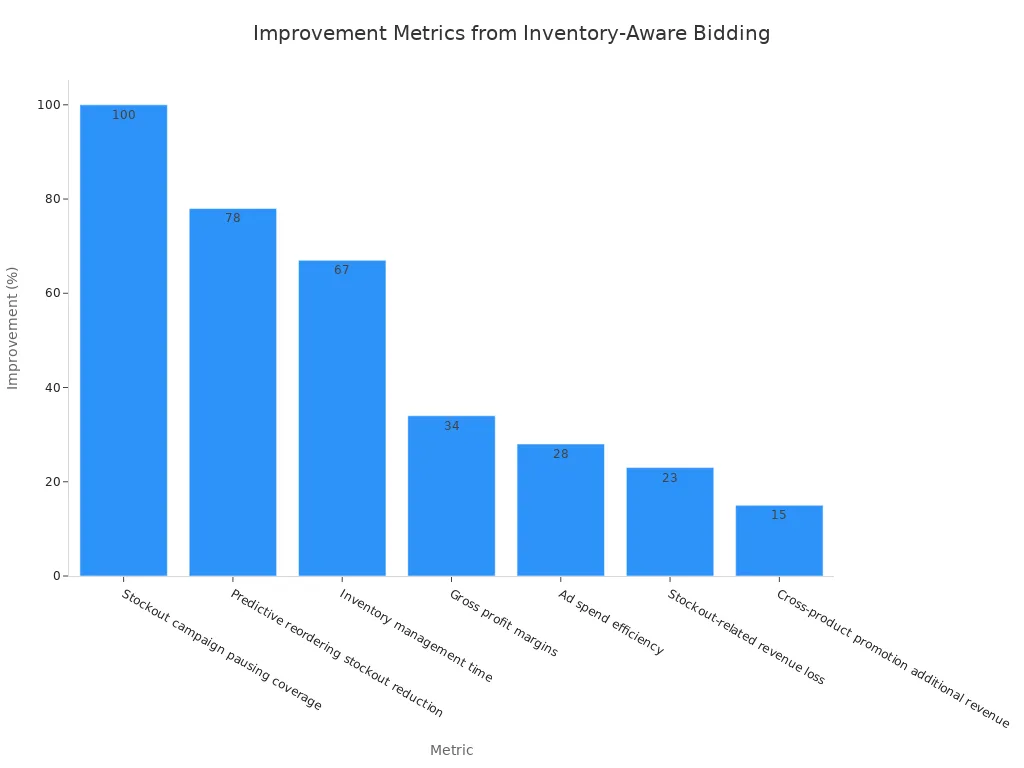
These strategies transform your retail operations:
- 28% increase in overall ad spend efficiency
- 67% reduction in manual inventory management time
- 100% automatic coverage for stockout campaign pausing
- 78% reduction in stockouts through predictive reordering
- 15% additional revenue from cross-product promotions
Feeding profit data into automation optimizes personalization and boosts overall marketing budget optimization. Smart balancing marketing spend elevates overall campaign responsiveness. You build resilient strategies by aligning ad budgets with real physical inventory.
Marketing Budget Optimization and Profit Metrics
Inventory-Driven Marketing Budget Optimization
Unchecked inventory costs drain your profit margins and limit business growth. Storage fees, expedited shipping fees, and inventory write-offs tie up cash that you could deploy elsewhere. Connecting warehouse turn rates directly to marketing budget optimization protects your overall cash flow. Aligning campaign spend with real-time product availability prevents money from trapping itself in unsold warehouse items. Smart marketing budget optimization balances storage expenses against customer acquisition costs. You achieve dynamic resource allocation by directing budget funds to products with abundant physical stock and accurate demand forecasting.
Effective inventory spend management requires disciplined open-to-buy planning. You should align your overall marketing strategies with dynamic buying budgets, seasonal trends, and upcoming product demand. Focusing your marketing budget optimization on high-margin products protects net cash reserves.
- Promote high-margin products with strong demand forecasts to increase gross profit.
- Avoid spending marketing budget on overstocked items or low-margin products that generate weak returns.
- Use demand forecasting to ensure complete stock availability before launching major ad pushes.
- Apply open-to-buy planning to align campaign investments with budget goals and inventory targets.
Balancing marketing spend with real-time stock counts secures your customer lifetime value. Smart budget allocation cuts your financial exposure to slow-moving inventory by ensuring you order just enough to meet consumer demand. This operational alignment turns inventory management from a financial drain into a predictable source of stability for your retail enterprise.
Evaluating Stock-Adjusted ROAS and Net Margin
Relying on platform-reported ROAS creates a dangerous disconnect from financial reality. Ad networks report high ROAS numbers, but true performance measurement demands tracking real contribution dollars. Privacy updates, broken attribution models, and over-estimated conversions make platform ROAS a vanity metric. You must transition from top-line ROAS to stock-adjusted ROAS and net profitability metrics to protect profit margins. Integrating live analytics gives your team direct visibility into backend product costs and inventory bottlenecks before ad spend waste happens.
Standard ROAS reflects artificial demand driven by platform spend rather than true retail market demand. Over-investing ad money in one item category creates inventory stockouts while hiding real market opportunities in under-advertised categories. Advanced profit optimization metrics solve these critical analytics blind spots.
| ROAS Limitation | Advanced Metric to Address It |
|---|---|
| Ignores true costs like COGS, shipping, and returns | Customer Acquisition Cost (CAC) |
| Misses backend revenue, repeat purchases, and loyalty | Customer Lifetime Value (LTV) |
| Focuses heavily on immediate short-term sales conversions | Customer Retention Rate |
| Disregards individual product net profit margins | Average Order Value (AOV) |
Transitioning to net profit targets requires careful execution to avoid common pitfalls in your promotional strategies. Setting an overly aggressive profit target immediately can starve active campaigns of ad traffic. You should begin with conservative targets, allow a four-week stabilization period, and raise targets cautiously in small increments. You must track all operational fees pessimistically to determine your true break-even threshold. Aligning your marketing budget optimization with stock turnover builds sustainable long-term strategies for growing bottom-line profit.
To align your operational workflows, connect your real-time inventory feed directly to ad platforms. You then build automated bidding rules to pause any active campaign when stock levels drop.
This technical integration transforms your marketing budget optimization. Using real inventory data and clear cash flow visibility drives net profit instead of vanity revenue metrics. Smart balancing marketing spend stops ad waste on scarce items while maximizing return on high-margin products. Aligning your marketing strategies with warehouse availability protects cash flow across all channels. Modern strategies rely on accurate spend controls. Audit your current marketing automation against live inventory systems today. Refine your budget allocation and budget workflows to maximize net earnings on every budget.
FAQ
How does dynamic bidding protect your marketing budget?
Dynamic bidding lowers your ad bids automatically when inventory drops. Lowering spend when stock falls below 30 days reduces wasted ad capital. You pause campaigns completely when stock drops below 7 days. This process cuts wasted spend by 67 percent.
Why should retail brands move away from standard ROAS?
Standard ROAS ignores actual product margins, return costs, and stock shortages. Platform reporting creates artificial demand numbers. Tracking stock-adjusted metrics helps retail businesses evaluate marketing success, protect true contribution dollars, and prevent cash flow stress.
What inventory data sources connect to digital ad networks?
You can connect your Product Information Management software and Enterprise Resource Planning platforms directly to ad channels. These live data pipelines feed real-time inventory levels to campaign automation systems for continuous optimization.
See Also
How Predictive Analytics Will Revolutionize Retail Restocking In 2025
Balancing Fashion Supply And Demand Through Advanced Predictive Analytics
Maximizing Operational Efficiency Using Smart Ecommerce Warehousing Strategies Today
Five Powerful Real Time Demand Forecasting Strategies For Businesses
Innovative Best Practices For Streamlining Retail Replenishment In 2024