

Generative AI gives you the power to speed up AI Product Design and spark new ideas. Tools like Claude, Perplexity, and Stable Diffusion help you create and test designs faster. Check out how organizations use these tools:
| Statistic | Value |
|---|---|
| Organizations investing in Generative AI | 90% |
| Organizations increasing investments in Generative AI | 67% |
Generative AI in AI Product Design
Accelerating design cycles
You want to move fast in AI Product Design. Generative AI tools like Claude, Perplexity, and Stable Diffusion help you do just that. These tools automate many steps, so you can create, test, and improve products in less time. You can see how much faster things get with generative AI compared to old methods:
| Evidence Type | Description |
|---|---|
| Generative Design | Automates the creation of optimized designs, so you can try more ideas fast. |
| Manufacturing Optimization | Makes sure your designs are easy to build and efficient to produce. |
| Productivity Increase | Teams using AI tools see up to 66% more productivity. |
| Real-time Feedback | You can respond to user feedback right away, which speeds up improvements. |
| Cycle Time Reduction | Generative AI can cut product development time by up to 70%. |
| Enhanced Testing | More time for testing and making your product better for users. |
Big companies already use these tools to get products to market faster:
| Example | Impact on Time-to-Market |
|---|---|
| L’Oréal | Turned weeks of meetings and research into days, so teams could focus on testing ideas. |
| Airbus | Made lighter cabin parts and cut prototyping time in half. |
| Autodesk | Reduced design iteration times by over 50% and cut material waste by up to 40%. |
Frameworks like GAI-PD also help you work smarter. They automate design steps and use real-time data to make quick changes. This means you can keep your product fresh and meet user needs faster.
Enhancing creativity and ideation
Generative AI does more than speed things up. It helps you think bigger and come up with new ideas. When you use tools like Stable Diffusion or Claude, you can brainstorm, create mockups, and get new insights in minutes. Here’s how these tools boost creativity:
- They help you generate ideas and mockups, so you spend less time on manual work.
- You get fresh insights that spark new directions for your product.
- AI-generated wireframes let you focus on creative choices, not just drawing.
In game design, over 90% of designers use generative AI for brainstorming and ideation. Many say these tools help them come up with proposals and spark new ideas. Nike uses AI to analyze athlete data, pick the best materials, and design lighter, stronger shoes. Their teams now prototype faster and personalize products for each customer. You can do the same in your projects.
Tip: Try using generative AI for your next brainstorming session. You might be surprised by the ideas you discover!
Designer roles and expertise
Your role as a designer changes when you use generative AI. You spend less time on repetitive tasks and more time making sure your product works well for users. Now, you can generate user flows, UI mockups, and even test different designs quickly. Here’s how your job evolves:
| Change in Design Process | Description |
|---|---|
| Timeline Reduction | AI compresses the design-to-prototype timeline from weeks to hours. |
| Prototype Generation | You can create user flows and mockups straight from a design brief. |
| User Behavior Simulation | Simulate how users interact with your product before you even build it. |
| A/B Testing Efficiency | Test different versions of your design quickly, without starting from scratch. |
You also need new skills. You become a curator of creativity, using AI outputs to solve problems. You need to tell stories, understand users, and know how to use digital tools like CAD or illustration software. You also need to know about materials and how things get made.
- Generative AI lets you spend more time testing and refining your ideas.
- You can use AI for market research, concept development, and quick testing.
- Collaboration between design and development gets easier and faster.
AI Product Design is not just about using new tools. It’s about using your expertise to guide AI and make products that people love.
Implementation and Business Value
Integrating generative AI into workflows
You can start using generative AI in your product design workflow with a few simple steps. First, set clear goals for what you want AI to do. Maybe you want to speed up ideation or improve testing. Next, pick user-friendly tools that fit your needs. Try tools like Claude or Stable Diffusion for brainstorming and concept sketches. Experiment with different prompts and approaches. Learn by trial and error.
Here’s a quick guide to help you integrate generative AI:
- Move from vague ideas to concrete designs faster.
- Generate multiple design variations and concept sketches quickly.
- Optimize designs based on constraints like weight or budget.
- Use AI as a collaborative tool to boost creativity and efficiency.
Tip: Start small. Launch a pilot project in a high-value area. This helps you see results and build confidence.
Many companies have already seen big benefits. Make The Dot uses AI to streamline the concept-to-sample process. Teams create accurate product renders and collaborate more easily. BMW uses AI for automated procurement reviews, making operations smoother.
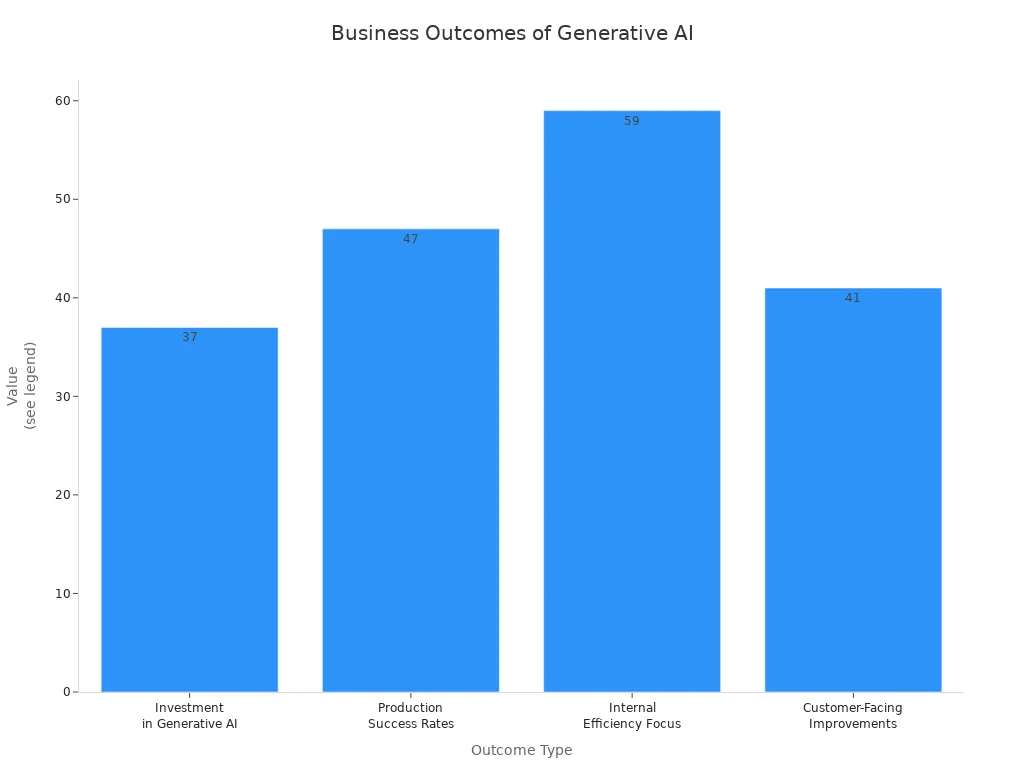
You can measure the impact of generative AI with clear business outcomes:
| Outcome Type | Statistic/Insight |
|---|---|
| Investment in Generative AI | Companies spent $37B on generative AI in 2025, a 3.2x increase from the previous year. |
| Production Success Rates | Production success rates have reached 47%, nearly double that of traditional SaaS. |
| Focus on Internal Efficiency | 59% of AI projects focus on improving internal efficiency. |
| Customer-Facing Improvements | 41% of AI projects aim to enhance customer-facing operations. |
Generative AI not only optimizes your workflow but also transforms your business. You can make decisions faster and reduce errors. This leads to savings and better ROI.
Overcoming challenges
You might face some hurdles when you bring generative AI into your workflow. Some team members may worry about job security. Others may not trust the new tools. Sometimes, AI tools don’t fit well with your current systems.
Here are common pitfalls and how to avoid them:
- Getting buy-in from team members who fear job displacement.
- Unclear rollout strategies causing confusion and resistance.
- Integration issues with existing workflows.
To overcome these challenges, try these solutions:
| Solution Type | Description |
|---|---|
| Approved AI Tools | Provide sanctioned AI tools with clear usage guidelines and training programs. |
| Employee Training and Enablement Plan | Develop structured training, including hands-on learning and certifications. |
| Shared Benefits Approach | Show how AI saves time and boosts productivity, turning resistance into enthusiasm. |
| Tiered Training Program | Offer multi-level training for different knowledge levels, addressing biases early. |
| Frictionless Learning | Create short, easy learning modules to encourage continuous learning. |
Note: Address fears by showing real examples of time savings. TechNET IT Recruitment saved 21 hours per week per employee with AI.
You also need to manage risks. Data privacy, intellectual property, and AI hallucinations are real concerns. Set up clear governance and accountability. Use technical controls to protect data. Make sure AI outputs match your business goals.
| Risk Type | Description |
|---|---|
| Data Privacy Breaches | Risks of confidential information being shared with AI tools that retain and use that data. |
| Intellectual Property Issues | Complications from AI-generated content that may infringe on existing IP rights. |
| AI Hallucinations | AI may generate plausible but incorrect information. |
| Security Vulnerabilities | Risks like prompt injection attacks can compromise system integrity. |
| Operational Risks | Overreliance on AI outputs can lead to costly mistakes. |
You can also face challenges like picking the right pilot project, educating stakeholders, and upskilling designers. Make sure your data is ready for AI tools. Address governance and security concerns.
| Challenge | Description |
|---|---|
| Identifying suitable pilot projects | Select high-value domains for pilot projects to maximize benefits. |
| Evaluating risks | Manage legal, ethical, and reputational risks with guardrails. |
| Educating stakeholders | Be transparent about generative AI and its limits to avoid overoptimism. |
| Upskilling designers | Train designers for new roles and skills. |
| Addressing internal resistance | Handle pushback from employees hesitant to adopt new tech. |
| Ensuring data readiness | Prepare data for use with generative AI tools. |
| Managing governance and security | Address IP rights and data security measures. |
Maximizing competitive advantage
You can use generative AI to get ahead of your competitors. AI Product Design lets you bring new products to market faster. You can run experiments in virtual environments, lowering R&D costs. Generative AI reduces product development cycle times by over 70%. Autodesk cut design iteration times by over 50% and material waste by up to 40%.
Here’s how you can drive innovation and measure success:
- Set aside time for learning and exploration. Test generative AI in product design.
- Launch a pilot project in a high-value area.
- Evaluate risks and set up guardrails for legal and ethical concerns.
- Educate stakeholders to manage expectations.
- Upskill designers for future roles.
You can track key performance indicators to measure success:
| Key Indicator | Value |
|---|---|
| GenAI market projection by 2032 | $200 billion |
| Organizations increasing GenAI investments | 67% |
| Organizations tracking productivity improvements | 38% |
| Consumers open to GenAI-enhanced products | 80% |
Generative AI helps you automate tedious tasks and speed up creative exploration. You can visualize and iterate on concepts rapidly. L’Oréal uses AI to personalize beauty product recommendations. Shopify uses AI to create product descriptions faster. Digital-twin technology lets you simulate product performance and get quick insights.
Tip: Use generative AI to create multiple design iterations based on consumer preferences. You can adapt quickly to market trends and predict popular styles.
AI Product Design gives you a real edge. You can focus more on consumer testing and refining designs. The tools help you develop better products faster. This drives innovation and keeps you ahead in the market.
| Benefit | Description | Source |
|---|---|---|
| Cost Reduction and Time Savings | Automating repetitive tasks leads to reduced operational costs and time savings. | Deloitte: 82% of leaders believe AI will improve employee performance. |
| Personalized Customer Experiences | Generative AI enhances customer interactions through personalized recommendations. | 73% of consumers expect enhanced personalization (Salesforce). |
| Increased Productivity | Automation of routine tasks allows employees to focus on higher-value activities. | AI can automate tasks that take up to 60-70% of employees' time (McKinsey). |
| Data Analysis and Insights | AI identifies trends and patterns in large datasets, aiding decision-making. | Generative AI excels in data analysis (Master of Code). |
| Improved Customer Service | Provides quick, accurate, and personalized responses, enhancing customer satisfaction. | Enhanced user experience can lead to increased revenue for enterprises (Master of Code). |
You can use generative AI to shorten innovation cycles. This lets you bring new products to market quickly and respond to customer needs faster. AI Product Design is your path to faster, smarter, and more creative product development.
You can speed up your design process and unlock new ideas with generative AI. Try playful exploration with these tools—unexpected results often spark creativity. Set aside time for testing and launch a small pilot project. Many teams, like L’Oréal and Airbus, already see big wins. Start your journey today!
FAQ
What is generative AI in product design?
Generative AI helps you create new ideas, designs, or prototypes quickly. You can use it to brainstorm, test, and improve products with less manual work.
Do I need to know coding to use generative AI tools?
No, you do not need to code. Many tools have easy interfaces. You can start by typing prompts or using templates.
How can I make sure AI-generated designs fit my brand?
Always review AI outputs. Adjust colors, fonts, and styles to match your brand. You stay in control of the final design.
See Also
Innovative AI Fashion Solutions For A Sustainable Future
The Role of AI in Managing Fast Fashion Trends
Accelerating Market Entry: AI's Impact on Lead Times