

Agentic Commerce is smarter because it moves much of the shopping work from you to AI agents. This change means you spend less time searching and more time getting what you want. You see real results in how you shop:
- Traffic to US retail sites from AI browsers and chat services jumped by 4,700% in one year.
- Shoppers using these tools spend 32% more time on sites and view 10% more pages.
- Bounce rates drop by 27% when people use AI-powered shopping.
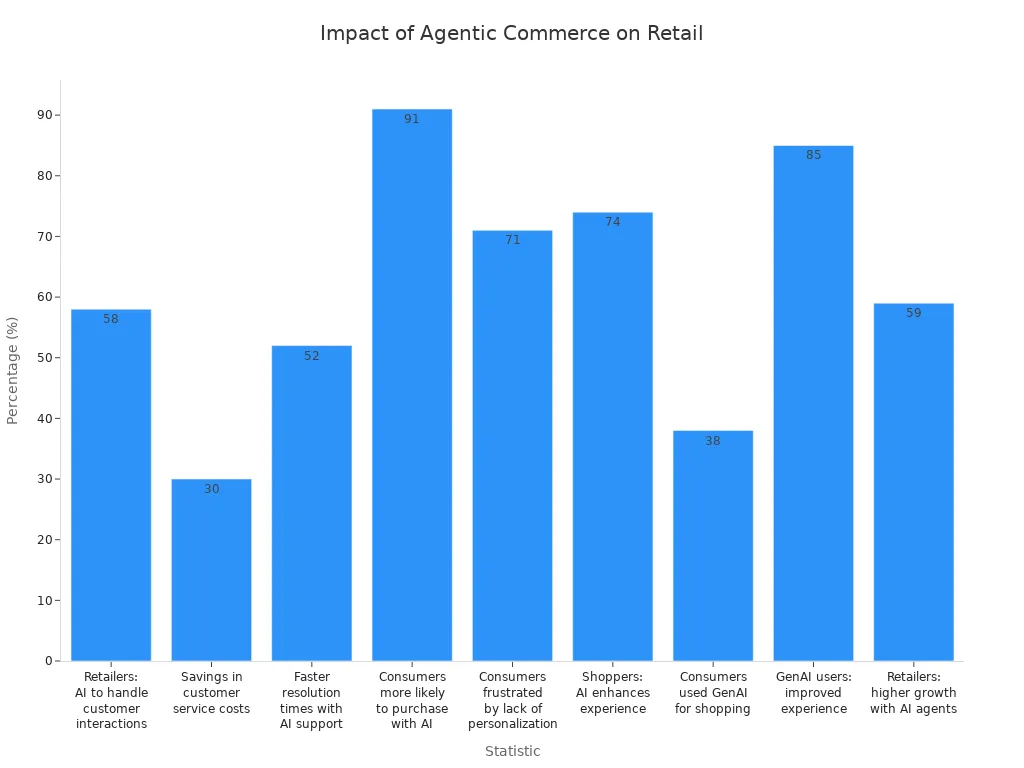
You feel the difference as a shopper. Merchants see big changes, too. AI agents help solve problems 52% faster and lower customer service costs by 30%. When you get better recommendations, you are 91% more likely to buy. This shift makes shopping easier for you and helps stores grow faster.
Agentic Commerce And Traditional Ecommerce Defined

Agentic Commerce Overview
You see agentic commerce as a new way to shop online. AI agents do much of the work for you. These agents can find products, compare prices, and even make purchases with your approval. They go beyond simple recommendations. You can let them handle logistics, setup, and ongoing product use. Some agents exist only online, while others have a physical form. You decide how much control you want. Sometimes you guide the agent, and sometimes it acts on its own.
Agentic commerce shifts shopping from manual browsing to intelligent software that understands your needs and manages tasks for you.
Here is a quick look at the main features:
| Characteristic | Description |
|---|---|
| Degree of autonomy | You choose between decision support or full agent negotiation. |
| Form of embodiment | Agents can be digital or physical. |
| Scope of activity | Agents help with buying, delivery, setup, and ongoing use. |
Traditional Ecommerce Automation
Traditional ecommerce relies on tools that help you shop but still require your input. You browse products, add items to your cart, and check out yourself. Automation supports you with marketing emails, customer service chatbots, and inventory management. These tools make shopping easier but do not take over the process. You stay involved at every step.
Here are common types of automation in traditional ecommerce:
- Marketing automation improves engagement and conversion.
- Email automation keeps you informed and builds loyalty.
- Customer service automation answers routine questions.
- Inventory management automation reduces errors and speeds up order processing.
Key Differences
You notice clear differences between agentic commerce and traditional ecommerce. Agentic commerce lets AI agents act for you, while traditional ecommerce depends on your actions. AI in agentic commerce can make decisions and solve problems. In traditional ecommerce, AI only suggests options or answers questions.
| Traditional ecommerce | Agentic commerce | |
|---|---|---|
| Execution | You complete each step manually. | The agent handles steps for you, with your approval. |
| AI Involvement | AI supports decisions. | AI takes action based on your goals. |
| Shopper Engagement | You stay involved throughout. | You engage at key points, like approving purchases. |
| Issue Resolution | You fix problems yourself. | The agent suggests solutions and asks for your approval. |
| Checkout Experience | Standard forms and checkout. | Agent-assisted checkout when available. |
| Fraud Detection | Human-led checks. | AI must spot helpful agents versus harmful bots. |
Agentic commerce offers more personalization and less manual effort. Traditional ecommerce gives you control but requires more time and attention.
Agentic Commerce vs Traditional Ecommerce: Core Comparison
User Involvement
You notice a big difference in how much you need to do when shopping online. In traditional ecommerce, you control every step. You search for products, filter results, compare prices, and complete transactions yourself. You stay active throughout the process.
Agentic commerce changes this. You tell the AI what you want, and it handles the hard work. The agent searches, compares, and even buys items for you. You only need to approve key actions. This makes shopping easier and less tiring.
| Aspect | Traditional Ecommerce | Agentic Commerce |
|---|---|---|
| User Control | You control every step of the process. | You approve key actions, AI handles tasks. |
| Engagement | Active navigation and manual transactions. | Passive experience, AI manages complexity. |
| Decision-Making | You make all purchasing decisions. | AI can make decisions within limits. |
- In traditional ecommerce, you spend time scrolling and filtering.
- Agentic commerce lets you state your needs, and the AI does the rest.
- You get a low-effort experience with agentic commerce.
AI Capabilities
AI plays a much bigger role in agentic commerce. You see digital sales agents that analyze your behavior and create custom quotes. Service agents give you 24/7 support and personalized recommendations. Product content agents keep product information accurate and up to date. Quality assurance agents check systems for errors. Procurement agents manage inventory and place orders automatically.
In traditional ecommerce, AI helps with simple tasks like product suggestions or chatbots. You still need to make decisions and complete actions. Agentic commerce uses advanced AI to handle complex jobs and support you throughout the shopping journey.
- Digital sales agents create tailored quotes for you.
- Service agents offer round-the-clock support and recommendations.
- Product content agents generate and optimize descriptions.
- Quality assurance agents monitor systems for consistency.
- Procurement agents manage inventory and trigger orders.
Agentic commerce uses AI to reason through your goals and adapt to your needs. The system can handle the whole buying cycle for you.
Personalization
Personalization makes shopping feel special. In traditional ecommerce, you get suggestions based on your browsing history. The system uses fixed rules and limited data. You still need to search and filter products yourself.
Agentic commerce takes personalization further. The AI learns from your feedback and context. It remembers your preferences and adapts to your needs. You interact with the agent in a conversational way. The agent finds products, compares options, and makes recommendations just for you.
| Feature | E-Commerce | Agentic Commerce |
|---|---|---|
| Shopper’s Role | Full control, manual searching and filtering | Guidance role, agent handles searching and filtering |
| Interaction Style | Browsing and clicking through menus | Conversational experience with AI agents |
| Level of Personalisation | Based on browsing history, often limited | Deep personalization, learns from feedback and context |
| Use of Artificial Intelligence | Limited to product suggestions and search autocomplete | Foundation of the system, enables decision-making |
| Speed and Convenience | Can be time-consuming and overwhelming | Saves time, reduces mental load, automates actions |
Agentic commerce gives you real-time, personalized help. You save time and get better results.
Speed And Convenience
Speed and convenience matter when you shop online. Traditional ecommerce can feel slow. You spend time comparing products, filling out forms, and searching for promo codes. You may abandon your cart if the process takes too long.
Agentic commerce speeds things up. AI agents move you from inspiration to purchase in seconds. They fill out forms, apply promo codes, and choose delivery options for you. You get hyper-relevant recommendations because the agent learns from your behavior.
- AI agents reduce friction and make checkout faster.
- You see fewer abandoned carts and higher conversion rates.
- Order fulfillment happens 40% faster with agentic commerce.
- Customer satisfaction rises, and support costs drop by half.
| Metric | Agentic Commerce | Traditional Ecommerce |
|---|---|---|
| Customer willingness to pay more | 52% for speedy service | N/A |
| Customer satisfaction | 30% more conversions | N/A |
| Support cost reduction | 50% reduction | N/A |
| Order fulfillment speed | 40% faster | N/A |
Agentic commerce makes shopping smoother and more enjoyable. You spend less time and get what you want faster.
Tip: If you want a shopping experience that feels effortless and personal, agentic commerce gives you the best results. You let the AI do the heavy lifting, and you enjoy the benefits.
Shopping Journey Examples

Agentic Commerce In Action
You start your online shopping journey by telling an AI agent what you need. The agent listens to your goals and sets up a plan. You see the agent search for products, compare prices, and check reviews. The agent can even buy the item for you after you approve the choice. You save time and avoid stress.
Many companies use agentic commerce to make shopping easier.
- Walmart uses agentic AI to manage inventory. You find fewer out-of-stock items because the system reduces shortages by 30%.
- H&M uses agentic AI to change store layouts. You notice bigger baskets and more choices because the system learns from your movement and purchases.
- Amazon and Shopify use agentic AI shopping assistants. You get personalized suggestions that match your style and needs.
Agentic commerce gives you deep personalization. The AI agent adapts to your feedback and learns from your actions. You get a shopping experience that feels unique and fast. You see automation at work, making each step simple.
Traditional Ecommerce In Action
You begin your online shopping journey by searching for products on a website. You scroll through pages, filter results, and compare prices. You add items to your cart and fill out forms to check out. You enter payment information and wait for confirmation.
The process in traditional ecommerce takes more effort. You handle each step yourself. You get product suggestions based on your browsing history, but personalization is limited. You spend more time searching and less time enjoying the experience.
Here is a table that shows the differences in each stage:
| Stage | Agentic Commerce | Traditional E-commerce |
|---|---|---|
| User-to-agent engagement | You set goals and constraints with AI agents. | You manually search and filter products. |
| Autonomous execution | AI agents complete transactions and monitor prices for you. | You check prices and complete purchases yourself. |
| Product discovery | AI analyzes product data to meet your goals. | You browse and search for products. |
| Merchant-to-agent interaction | Machine-readable interfaces allow seamless communication. | You interact with websites in a standard way. |
| Secure transactions | Advanced authentication systems handle automated purchasing. | You enter payment information manually. |
You see that agentic commerce makes online shopping easier and faster. Traditional ecommerce gives you control but requires more work. Personalization and AI help you in both systems, but agentic commerce uses them to create a smarter journey.
Impact On Shoppers And Merchants
Shopper Experience
You notice a real difference in your shopping journey when you use agentic commerce. AI agents help you find products faster and answer your questions right away. You do not need to scroll through endless pages or search for answers in long FAQ sections.
Agentic commerce enhances shopper experience by enabling personalized and efficient interactions, leading to better customer service, faster product discovery, and a more engaging shopping experience.
- You get answers to product questions much faster than reading FAQ pages.
- You discover products quickly without clicking through many categories.
- You enjoy more convenience because agents handle routine tasks, like restocking or alerting you to new items.
AI agents act as your shopping helpers. They focus on making products and services easier for you to access. You feel less friction and enjoy more personalization during your ecommerce experience.
Merchant Operations
As a merchant, you see big changes in how you run your store. AI agents take over many routine jobs, so your team can focus on bigger goals. You spend less time on customer service because agents answer questions and solve problems quickly. Inventory stays up to date, and you avoid running out of popular products.
You also notice that agentic commerce tools help you reach shoppers in new ways. Agents can talk to customers, learn from their feedback, and adjust offers in real time. This makes your ecommerce business more flexible and responsive.
Conversion And Risk
Agentic commerce changes how you track and manage sales. The path from browsing to buying becomes shorter, but you may lose some visibility into what shoppers do. You might find it harder to recognize returning customers or understand their full journey.
| Aspect | Agentic Commerce | Traditional Ecommerce |
|---|---|---|
| Conversion Paths | Offers new paths but may create visibility gaps | Established paths with clear visibility |
| Risk Management | Faces challenges due to data abstraction | Relies on comprehensive customer data |
| Customer Recognition | Limited ability to recognize returning users | Stronger customer profiling capabilities |
- Agentic commerce can create gaps in trust and long-term relationships if you cannot see all customer actions.
- Without key data, you may struggle to understand what shoppers want or how much they are worth to your business.
- The purchase process moves faster, but you might miss chances for deeper engagement.
AI brings speed and efficiency to ecommerce, but you need to balance these gains with careful risk management and a focus on building trust.
Challenges And Considerations
Security And Trust
You need to trust the system when you let ai agents shop for you. Many people worry about security and fraud in agentic commerce. A recent report showed that 42% of businesses feel uneasy about ai agents making purchases for customers. You want to know what these agents do with your data and money.
Cybersecurity experts say you should look for these features:
- Clear audit trails and easy-to-read explanations.
- Checks that make sure outcomes match your instructions.
- Real-time alerts for strange activity and ways to undo mistakes.
You also need to see what ai agents do. Trust grows when you can control agent actions and stop anything that feels wrong. Security threats and new rules can make things tricky. You must stay alert and ask for strong protections.
Tip: Always check if the platform gives you visibility into agent actions and lets you set limits.
Implementation Barriers
Switching from traditional ecommerce to agentic commerce brings challenges. You may face problems with data, language, and fast-changing products. Here is a table that shows common barriers:
| Challenge Type | Description |
|---|---|
| Inconsistent Data Formats | Different suppliers use varying formats, making it hard for ai agents to compare products. |
| Incomplete Information | Many listings miss key details, so agents cannot match products to your needs. |
| Rapidly Changing Inventory | Keeping inventory up to date across channels is tough. |
| Multilingual and Regional Variations | Product names and specs change by region, confusing ai agents. |
You also need to think about privacy. Ai agents handle your personal data, so you want strong security. Heavy use of ai can cause problems if the system fails. New laws about ai add more uncertainty.
Future Readiness
You want to know if agentic commerce will last. Industry leaders see fast growth in ai-driven shopping. In just nine months, traffic from ai agents grew by 1300%. Most of this growth happens in retail, streaming, and travel.
Here is how agentic commerce compares to traditional ecommerce automation:
| Metric/Capability | Agentic Commerce | Traditional Ecommerce Automation |
|---|---|---|
| Growth in AI-driven traffic | 1300% increase in 9 months | N/A |
| Focus areas | Product research and discovery | N/A |
| Foundational capabilities | Machine-readable catalogs, AI traffic signals, agent-ready interfaces | N/A |
| Speed of automated traffic growth | 8 times faster than human traffic | N/A |
| Concentration of AI-driven traffic | 95% in retail, streaming, travel | N/A |
You see that agentic commerce moves quickly. You need to prepare for new technology and changing rules. Staying informed helps you make smart choices as ai changes how you shop and sell.
Which Is Smarter?
Summary Table
You want to know which approach is smarter. Agentic commerce uses AI agents to handle tasks for you. Traditional ecommerce automation relies on you to do most of the work. The table below shows how each system works and what matters most for smart shopping.
| Traditional ecommerce | Agentic commerce | |
|---|---|---|
| Who executes the steps | You complete each step manually. | The agent handles steps for you, with your approval. |
| AI’s role in the process | AI suggests options and answers questions. | AI takes action based on your goals and constraints. |
| How products are narrowed down | You search, filter, and compare across pages. | The agent prepares a cart based on your directions. |
| Where you are engaged | You stay involved throughout the journey. | You approve key decisions, like item selection and payment. |
| How issues are handled | You fix problems yourself. | The agent proposes solutions and asks for your approval. |
| Checkout experience | Standard forms and authentication steps. | Agent-assisted checkout or handoff to merchant checkout. |
| Fraud and risk signals | Risk models rely on human-led behavior and device patterns. | You must confirm intent and spot helpful agents versus bots. |
You can also look at key metrics that help you decide which system is smarter:
| KPI | Why It Matters |
|---|---|
| AI referral traffic | Shows how much AI influences site visits and product discovery. |
| Share of AI recommendations | Measures how often your brand appears in AI product suggestions. |
| AI-assisted conversion rate | Tracks how often AI-driven sessions lead to purchases. |
| Product feed completeness | Ensures agents have enough information to recommend products accurately. |
| Revenue from AI-mediated journeys | Connects AI-driven shopping to sales results. |
| Checkout completion from AI-assisted sessions | Checks if shoppers finish purchases after AI recommendations. |
| AI answer accuracy | Monitors how well AI describes products and retailers. |
Note: Agentic commerce gives you more speed and personalization. You spend less time shopping and get better results. Traditional ecommerce gives you more control but requires more effort.
Agentic commerce stands out as the smarter choice for speed, personalization, and efficiency. You benefit from AI agents that handle tasks, making shopping less exhausting. Merchants gain leaner operations and a competitive edge. See the main differences below:
| Traditional ecommerce | Agentic commerce |
|---|---|
| Manual browsing and buying | AI agents act automatically |
| UX drives conversion | APIs drive discoverability |
| Personalization through cookies | Real-time context exchange |
FAQ
What is the main benefit of agentic commerce for shoppers?
You save time and effort. AI agents handle searching, comparing, and buying. You only approve key steps. This makes shopping faster and less stressful.
How does agentic commerce help merchants?
You see fewer routine tasks. AI agents manage inventory, answer questions, and personalize offers. Your team can focus on growth and strategy.
Is agentic commerce safe to use?
Always check for strong security features. Look for clear audit trails, real-time alerts, and easy ways to control agent actions. These help keep your data and money safe.
Can I still control my shopping with agentic commerce?
Yes! You set your goals and approve important decisions. The AI agent works for you, but you stay in charge of what gets bought.
See Also
Strategic Ecommerce Approaches for 2025: A Practical Guide
The Evolution of Ecommerce Services in the Future
Enhancing Efficiency Through Intelligent Ecommerce Warehouse Solutions
Top 10 E-commerce Platforms for Seamless Accounting Integration
Impress Customers Using Advanced Machine Learning Order Systems