
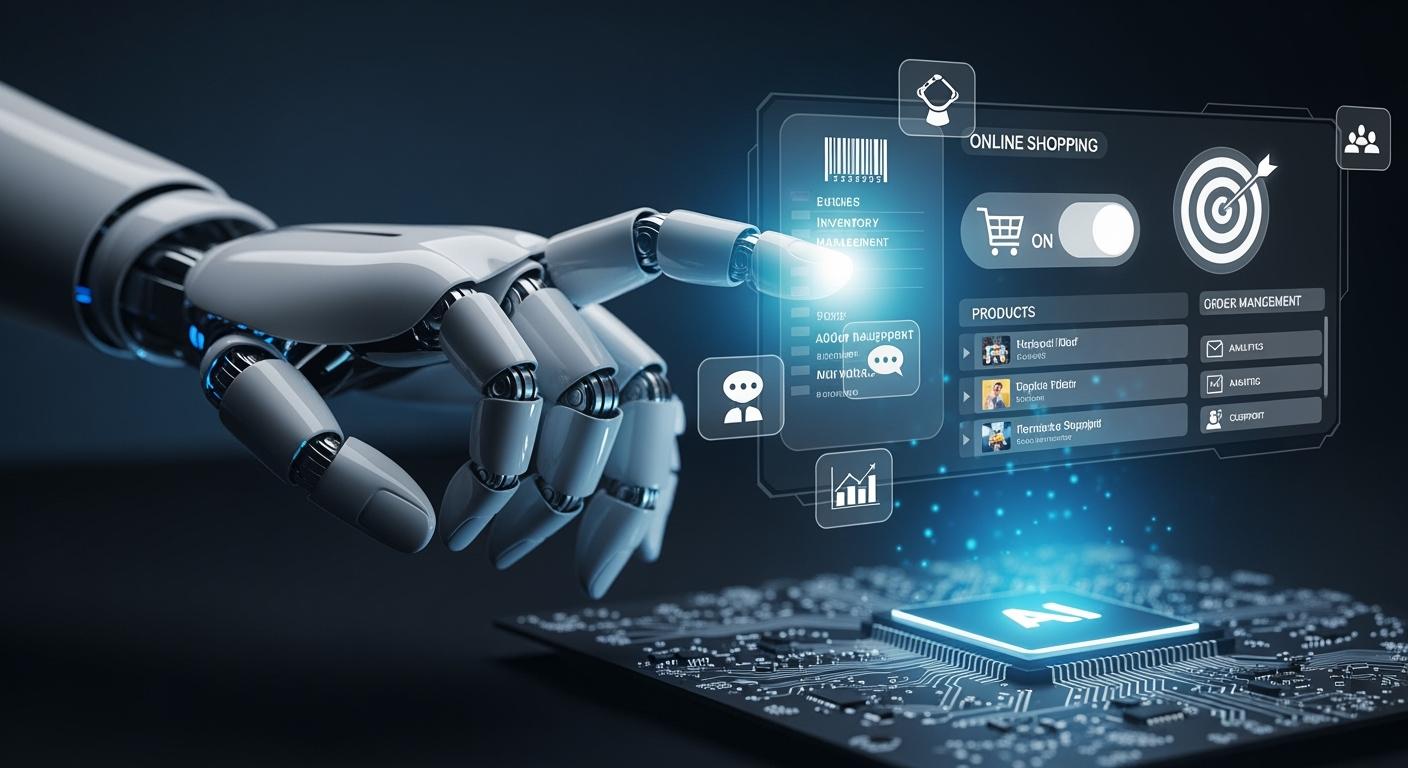
You can now rely on ai agents to manage every aspect of your ecommerce store. These agents handle daily operations, optimize pricing, and personalize offers using advanced ai. Many retailers have embraced this shift.
- 42% of ecommerce stores have already deployed ai agents
- 53% are actively evaluating ai for end-to-end management
Ai agents analyze purchase patterns, cart behavior, and inventory levels. They help you focus on creative strategies while improving efficiency and scalability. Ai transforms ecommerce by making your store smarter and more responsive.
AI Agents in Ecommerce

What Are AI Agents?
You can think of ai agents as digital workers that use ai to make decisions and take actions in your ecommerce store. These agents do not just follow simple rules. They learn from data, adapt to new situations, and interact with customers or systems in a smart way. For example, ai agents can answer customer questions, recommend products, or adjust prices based on demand. You do not need to program every step. The agents use ai models to understand what is happening and choose the best action.
Many people believe some common myths about ai agents in ecommerce. You might hear that ai is a magic wand that gives instant results. In reality, ai agents need time to learn and improve. Some worry that ai will replace human jobs. In most cases, ai agents help your team by handling routine tasks, so people can focus on creative work. You may also think that using ai in ecommerce costs a lot. Today, you can start small because ai is more accessible. Some fear that ai puts customer data at risk. You can protect data by using strong security measures. Finally, ai agents do much more than simple tasks. They can handle complex workflows and improve your store’s efficiency.
AI Agents vs. Traditional Tools
You might wonder how ai agents compare to older automation tools in ecommerce. The table below shows the main differences:
| Feature | Traditional Automation | AI Agents |
|---|---|---|
| Decision Logic | Hard-coded, rule-based | Contextual, model-driven |
| Learning / Adaptation | None | Continuous learning from data |
| Data Types Supported | Structured only | Structured + unstructured (text, voice, image) |
| Flexibility | Low | High—self-adjusts with feedback |
| Scalability | Medium | High—handles complex workflows |
| Interaction Style | Fixed UI or API | Conversational, natural language |
| Response to Exceptions | Manual intervention | Intelligent routing, asks questions |
| Maintenance | High | Lower—auto-improves over time |
| Deployment Speed | Fast for simple tasks | Faster adaptation after setup |
| Oversight Needs | Easier audits | Needs model monitoring and explainability |
You can see that ai agents bring more flexibility and intelligence to ecommerce. They learn from experience, handle many types of data, and adapt to changes. This means your store can grow and respond to customer needs faster.
Setting Up AI Agents
Getting started with ai agents in ecommerce involves a few clear steps. You need to choose the right tools, set up safe boundaries, and connect your data systems. This process helps you unlock the full power of autonomous ai agents while keeping your store secure and efficient.
Selecting AI Agents for Ecommerce
When you pick ai agents for your ecommerce store, look for these key features:
- NLP maturity and accuracy: The agent should understand shopper questions and product details.
- High deflection rate and customer satisfaction: Good ai agents solve many issues on their own and keep customers happy.
- Personalization depth: The agent should use different data types to make smart recommendations.
- Integration with product catalog, order management, CRM, and email systems.
- Multilingual support for global customers.
- Strong client reviews and a good reputation.
- Proven expertise in retail.
- Dedicated support from the vendor.
- Security, privacy, and GDPR compliance.
- Governance controls for risk management.
Choosing ai agents with these features helps you build a strong foundation for your ecommerce operations.
Defining Roles and Guardrails
You must give each ai agent a clear job and set limits to keep your store safe. Use the principle of least privilege. Each agent should access only what it needs. For example, a support triage agent might have these settings:
| Agent Role | Allowed Tools | Data Sources | Write Access | Approval Required | Logging Level |
|---|---|---|---|---|---|
| Support Triage Agent | Ticketing, knowledge base, email draft | CRM (read), support tickets, help docs | Draft only, no send | Needed before sending customer messages | Full: all tool calls and outputs logged |
Other best practices include:
- Make a list of allowed tools for each agent.
- Use separate credentials for every tool.
- Set limits for agent actions, like max iterations or spend.
- Check all inputs and outputs for errors.
- Remove sensitive data before it reaches the ai model.
Data Integration and Deployment
Connecting ai agents to your ecommerce data is key. You may face challenges like data quality, trust, and privacy. To solve these, use platforms that support easy integration and strong security. Start with one or two use cases, such as order tracking or product recommendations. Test results for 30-90 days and track customer satisfaction. The usual steps are:
- Plan and prepare your data.
- Develop and test the ai agent.
- Deploy in your ecommerce store.
- Monitor and improve performance.
Stay transparent about what your ai agents can do. Make sure customers know when they interact with autonomous ai agents. This builds trust and keeps your store ready for future changes.
AI Agents in Store Operations
Merchandising and Product Recommendations
You can use ai agents to transform merchandising and product recommendations in your ecommerce store. These agents use automation to make decisions about which product to show, when to show it, and to whom. They analyze data from every online shopping session, including browsing history and purchase patterns. This helps you deliver personalized shopping experiences that boost engagement and increase sales.
Here is how ai agents optimize merchandising and product recommendations:
| Functionality | Description |
|---|---|
| Autonomous Decision-Making | Ai agents automate the decision-making process, reducing manual effort in merchandising. |
| Real-Time Data Analysis | Ai agents analyze large amounts of behavioral data in real time to present the right product. |
| Personalized Customer Experiences | Ai agents tailor product recommendations based on individual preferences, improving conversion rates. |
| Inventory Management | Ai agents track inventory levels and suggest replenishment orders, optimizing supply chain efficiency. |
| Pricing Strategy | Ai agents negotiate pricing with suppliers and apply personalized promotions, improving margins and customer satisfaction. |
You will notice that ai agents do more than just suggest products. They manage inventory, set prices, and create personalized promotions. This level of automation leads to better engagement and a smoother customer journey.
Many ecommerce stores have seen measurable improvements after using ai-driven solutions for product recommendations:
- Product recommendations can increase conversions by up to 150%.
- Retailers using ai recommendation engines have seen conversion rates more than double.
- A sportswear brand achieved a 49x ROI and a 700% increase in customer acquisition.
- Ai-powered product recommendations typically drive 15-35% conversion increases on average.
- Leading implementations can achieve conversion rate improvements of 50-100%.
- Some campaigns have delivered 94% higher conversion rates.
With ai agents, you can deliver automated product recommendations that adapt to each customer. This helps you create a more engaging shopping experience and keeps your store ahead in the world of online shopping.
Order Management and WISMO Automation
Order management is a key part of ecommerce operations. Ai agents handle this with speed and accuracy. They provide real-time updates on order status, answer "Where Is My Order" (WISMO) questions, and send proactive notifications. This reduces customer anxiety and builds trust.
| Capability | Description |
|---|---|
| Real-time updates | Ai agents provide immediate updates on order status, improving the shopping experience. |
| Proactive notifications | Alerts at key delivery milestones can decrease WISMO inquiries by 50-80%. |
| Customer identification | Ai agents recognize customers without needing an order number, making online shopping easier. |
| Integration | Ai agents connect with ecommerce platforms and helpdesks for efficient order management. |
| Escalation | Ai agents escalate complex issues to human agents with full context, ensuring smooth customer interactions. |
You will see several benefits from this automation:
- Ai agents reduce repetitive WISMO inquiries.
- They increase customer trust through proactive updates.
- Human agents can focus on complex issues.
- Overall customer satisfaction and loyalty improve.
WISMO requests often make up 30-40% of support tickets in ecommerce. Automated solutions can reduce support costs by 50-75%. Up to 70% of WISMO inquiries can be answered automatically. One company saved €5,000 monthly in support costs, with annual savings of €54,000 from efficient processes. This shows how ai-driven solutions can streamline your operations and improve the shopping experience.
Returns, Exchanges, and Customer Support
Returns and exchanges are common in online shopping. Ai agents handle these tasks with automation, making the process easy for both you and your customers. They check tracking numbers, process return and exchange requests, and answer product questions. Ai agents also help with account management and clarify shipping policies.
| Task | Description |
|---|---|
| Order status inquiries | Ai agents check tracking numbers and provide updates on shipment status. |
| Return and exchange requests | Ai agents process requests by checking eligibility, generating return labels, and issuing refunds. |
| Product questions | Ai agents answer inquiries about product specifications and features. |
| Account management | Ai agents assist with password resets and account updates. |
| Shipping policy clarifications | Ai agents clarify shipping policies and procedures for customers. |
| Autonomous resolution | Ai agents handle in-policy returns and exchanges, and issue refunds below a certain threshold. |
| Escalation of complex issues | Ai agents escalate complicated requests to human agents with full context. |
Vodafone's ai agent handles over 70% of customer inquiries without human help. This led to a 47% reduction in average resolution time. Customer satisfaction ratings remain high, even with a large volume of inquiries managed by ai agents. Many global customer service managers now use generative ai to analyze customer sentiment. Ai agents give real-time, sentiment-aware suggestions to human agents. This proactive approach improves the overall shopping experience and keeps your customers happy.
AI Shopping Agents and Agentic Commerce
Ai shopping agents are changing the way people shop online. These autonomous software entities act on behalf of consumers to make purchases. They use conversational ai to understand user preferences, search for products, negotiate prices, and complete transactions. This creates a seamless shopping experience and brings a new level of automation to ecommerce.
You can expect ai shopping agents to:
- Learn user preferences and anticipate future needs.
- Search and evaluate products based on learned preferences.
- Monitor prices and negotiate with sellers for the best deals.
- Complete transactions using the user's preferred payment methods.
- Automate backend processes, improving efficiency.
- Analyze customer data for tailored product suggestions.
- Monitor stock levels and manage replenishment.
Agentic commerce represents a shift from traditional online shopping to a model where ai agents handle the entire process. For example, conversational commerce helps users find products by answering questions and showing options. Agentic commerce goes further by analyzing user habits and preferences to make purchases automatically, such as ordering running shoes when certain conditions are met.
Real-world results show the power of ai shopping agents. One implementation led to a 10% increase in website revenue, a 6% boost in search conversions, and a 7% increase in click-through rate. These agents deliver personalized shopping experiences, drive engagement, and optimize every step of the customer journey.
With ai-powered chatbots and ai-driven solutions, you can automate product discovery, recommendations, and transactions. This level of automation helps you stay competitive in the fast-changing world of ecommerce and delivers a superior shopping experience for every customer.
Outcomes of AI in Ecommerce
Efficiency and Cost Savings
You can achieve impressive efficiency gains when you use ai agents in ecommerce. These digital workers handle thousands of customer inquiries at once, something human teams cannot match. Ai agents automate repetitive tasks, which reduces labor costs and improves workflows. You see faster decision-making because ai processes large data sets in real time. Many businesses report a cost reduction of 10% to 19% in supply chain management after implementing ai. Ai agents also help recover abandoned carts, optimize inventory, and detect fraud early. This leads to better cash flow and fewer lost sales. You notice that 88% of organizations experience a positive revenue impact from ai, with 30% seeing over 10% revenue growth.
Ai enables you to scale customer service without increasing costs, making your resources more efficient.
| Contribution | Description |
|---|---|
| Inventory Optimization | Ai agents maintain optimal inventory levels, reducing excess stock and preventing stockouts. |
| Fraud Detection | Ai monitors transactions in real time, saving costs from chargebacks and lost sales. |
| Cart Recovery | Ai agents recover 8-12% of abandoned carts through personalized interventions. |
| Back-office Efficiency | Automating tasks reduces labor costs and allows focus on strategic work. |
Personalization and Customer Experience
Ai in ecommerce transforms the customer journey. Ai agents analyze browsing behavior, cart activity, and purchase history to deliver hyper-personalized product recommendations. You receive tailored suggestions and clarifications from intelligent virtual shopping assistants. Ai agents personalize every step, from homepage banners to checkout incentives, based on your profile. This dynamic approach improves the ecommerce buyer journey and increases satisfaction.
- Ai agents interpret user intent to provide unique recommendations.
- They adapt suggestions based on your immediate browsing context.
- Ai automates support tasks, making your experience seamless.
You see real results. Yves Rocher increased purchase rates 11 times after using ai personalization. Companies investing in customer-centric innovation report a 5-10% rise in satisfaction scores. Sephora saw a 25% uplift in sales with augmented reality tools.
Scalability and Competitive Advantage
Ai agents help you scale operations without adding staff or complexity. You handle more workflows and customer interactions as your business grows. Ai in ecommerce reduces bottlenecks and improves control. These agents monitor and act autonomously, speeding up order processing and reducing manual work. Companies using ai personalization see a 40% increase in sales compared to others. Ai agents improve first-contact resolution by 75% and boost conversion rates by 34%. You gain faster support, better customer interactions, and higher revenue. Ai in ecommerce lets you focus on high-value tasks, giving you a strong competitive edge.
Tip: Keep human oversight for complex customer interactions to ensure empathy and problem-solving.
You can transform your ecommerce store with AI agents. These digital workers automate tasks, optimize pricing, and personalize shopping. The table below shows how AI agents drive value:
| Capability | Impact |
|---|---|
| Dynamic Pricing | Boost margins with real-time price adjustments |
| Inventory Management | Reduce costs and prevent lost sales |
| Fraud Detection | Improve speed and accuracy in spotting fraud |
| Personalization | Deliver tailored recommendations |
| Returns Automation | Shorten wait times and lower support volume |
To start, follow these steps:
- Define your goals for AI agents.
- Check if your tasks need autonomy.
- Align agent actions with business outcomes.
- Review costs and expected gains.
AI agents help you grow your business and stay competitive. You can find services that make adoption easy and fast.
FAQ
How do AI agents keep my customer data safe?
You control what data AI agents can access. Most platforms use encryption and follow strict privacy rules. You can set limits and monitor agent actions to protect sensitive information.
Can AI agents replace my entire support team?
AI agents handle routine questions and tasks. You still need people for complex issues or special cases. AI helps your team focus on important work.
What happens if an AI agent makes a mistake?
You can set up alerts and approval steps. If an agent acts incorrectly, you review logs and adjust its settings. Human oversight helps prevent big problems.
How much time does it take to set up AI agents?
You can start with basic tasks in a few days. Full integration may take a few weeks. Most vendors offer support to help you launch faster.
See Also
The Evolution of Ecommerce Services for Future Growth
Enhancing E-Commerce Performance with TAGG Logistics in 2025
Actionable Strategies for Ecommerce Enablement in 2025
Top 10 E-Commerce Platforms for Seamless Accounting Integration
Enhancing Efficiency Through Intelligent Ecommerce Warehouse Solutions