

You need to measure Autonomous Commerce ROI in 2026 because the stakes have never been higher. Recent industry data shows just how much impact autonomous systems can deliver:
- Over 54 data points document adoption and ROI for autonomous campaigns.
- McKinsey finds a 10–20% sales ROI improvement from AI.
- The CMO Survey reports a 10.8% drop in overhead costs.
- Salesforce saw $262 billion in AI-attributed orders during the holiday season.
- Yet, 51% of organizations cannot measure AI ROI, showing a major gap.
| Metric | Value |
|---|---|
| Capacity Released | 43% |
| Throughput per Employee | 60% increase |
| First-Time-Right Rate | 99% |
| Quote-to-Order Win Rate Uplift | 18% increase |
| Payback Period | Under 12 months |
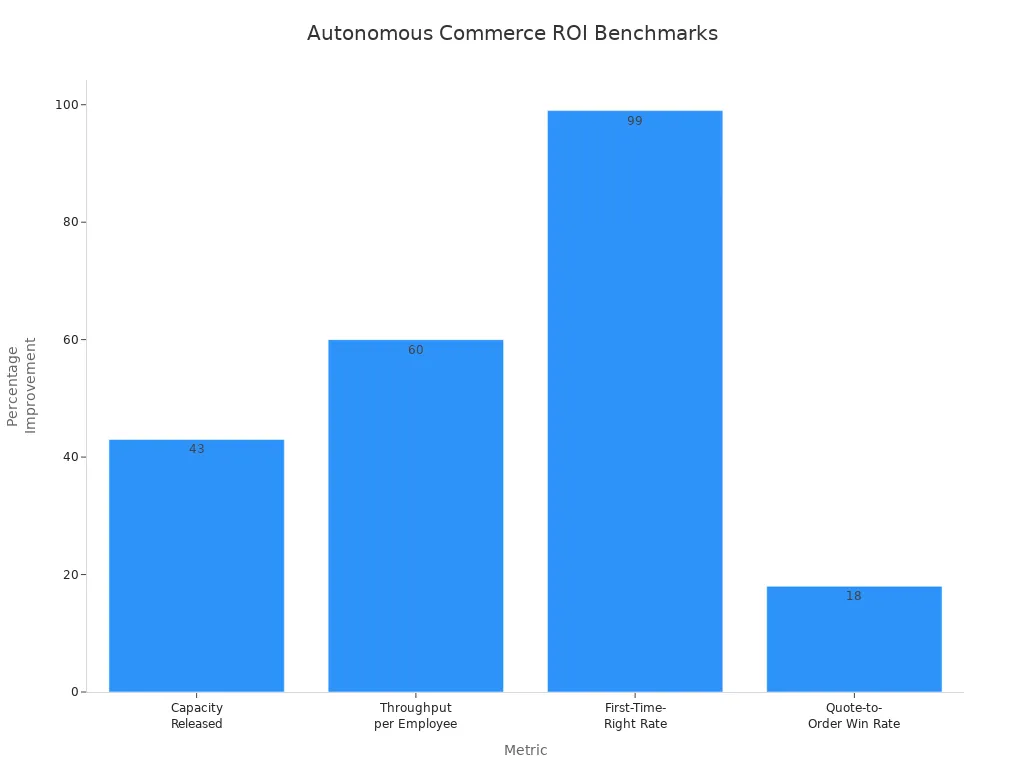
You face a complex challenge. Accurate measurement means real business value. Look for clear metrics and practical solutions to help you track your own results.
Measuring Autonomous Commerce ROI

Direct ROI Measurement Approaches
You need to use the right tools and methods to measure autonomous commerce roi. Many organizations now use Autonomous ROI Engines. These engines use advanced analytics and machine learning to track value in real time. You can see both value creation and value loss as it happens. This is different from old methods that only give you reports every month or quarter.
You should also know that predictive modeling is now part of these engines. This means you can forecast future value based on current trends and past results. In the past, you might have looked at open rates or click-through rates. Today, you focus on deeper metrics like revenue per email and customer lifetime value. These metrics give you a better picture of the roi of autonomous commerce.
Here are some ways organizations measure roi in autonomous commerce:
- Use Autonomous ROI Engines for real-time tracking.
- Apply predictive modeling to forecast future gains.
- Focus on metrics that show business outcomes, not just activity.
- Adopt Unified Commerce Platforms to streamline buying and reduce decision fatigue.
Early adopters often report their results using these new methods. For example, a steel manufacturer used ai-driven predictive maintenance to cut downtime by 40% and maintenance costs by 30%. They saw rapid roi in just six months. An online fashion retailer used ai for customer segmentation and increased annual revenue by $2 million. These stories show how scaling ai can boost autonomous commerce roi.
Key Metrics for Year One
You need clear, actionable metrics to measure roi in your first year. Tracking the right numbers helps you see progress and make smart decisions. Here is a table of key metrics you should watch:
| Metric | Description | Example Impact |
|---|---|---|
| Labor Cost Reduction | Lower workforce expenses due to automation. | Savings show up in profit and loss statements. |
| Automation Rate | Percent of processes automated. | Higher rates mean more efficiency and lower costs. |
| Process Improvement Rate | How much you improve your operations. | Faster service and fewer errors. |
| Revenue Growth Attribution | Revenue increases linked to ai implementation. | Shows how ai drives growth. |
| Customer Satisfaction Score | How happy your customers are with your service or product. | Higher scores mean better retention and more sales. |
| Net Promoter Score | How likely customers are to recommend you. | High scores can lead to more upsell and long-term growth. |
Most early adopters see positive results in year one. In fact, 88% of them report positive roi. Many also see a 30% drop in operational costs when they use agentic ai. These numbers set a strong benchmark for your own autonomous commerce roi journey.
Expected Results and Benchmarks
You should set clear expectations for your autonomous commerce roi. Recent data shows a 43% increase in capacity and a 1.7x to 10x roi for early adopters. Some companies see performance speeds 2.5 times faster and time-to-market improvements of up to 70%. The ai agents market is growing fast, from $7.7 billion in 2024 to a projected $282.6 billion by 2034.
Here is a table with some recent benchmarks:
| Metric | Value |
|---|---|
| Capacity Increase | 43% |
| Performance Speed | 2.5x faster |
| Time-to-Market | 60-70% faster |
| Positive ROI Rate | 88% of early adopters |
| Cost Reduction | 30% with agentic AI |
You can also look at real-world examples. A company that replaced its customer service team with an ai chatbot saved $100,000 each year and saw a 400% roi. Another company used ai-driven recommendations to increase repeat purchases by 15%, boosting long-term revenue without extra marketing costs.
You need to scale ai across your business to maximize the roi of autonomous commerce. When you do this, you can expect faster results, lower costs, and higher customer satisfaction. Tracking these benchmarks helps you see where you stand and where you can improve.
ROI Measurement Changes in 2026
Advances in Analytics and Automation
You see big changes in how you measure roi from autonomous commerce in 2026. New analytics tools let you track ai-driven results with more detail and speed. You can use platforms like AppsFlyer's Data Collaboration Suite to combine datasets securely. This helps you get a clearer picture of how ai impacts your business. Agentic ai suites automate workflows and give you real-time insights. You can measure time savings, quality improvements, revenue impact, error reduction, and opportunity cost. These tools help you understand how ai changes your operations.
| Key Theme | Description |
|---|---|
| Shift to Execution | AI budgets now depend on proof, not hype. |
| AI Performance Metrics | You focus on 15–20 core metrics, like Time-to-Value and Productivity Lift. |
| Time-to-Value | AI must show impact within 90–180 days. |
| Chief AI Officer Role | Over half of Global 1000 companies have a CAIO leading AI strategy and roi. |
| Value-Delivered Pricing | Many contracts use outcome-based pricing for ai solutions. |
Shifting Business Priorities
You notice that business leaders now want clear proof of ai value. CEOs measure roi by integrating ai into core processes and tracking its effect on productivity, innovation, and customer experience. Only a small group of commerce media leaders have advanced measurement maturity. Most decision-makers in North America and Europe focus on strengthening measurement and attribution to prove roi.
In 2026, ai does more than optimize media. It connects fragmented data, automates attribution, and enables real-time decision-making.
You also see organizations expanding their roi frameworks. They look beyond financial returns. You measure operational, capability, human capital, and strategic positioning values. You ask how ai affects your talent strategy, competitive position, and future opportunities.
Industry Trends and Projections
Agentic commerce rises fast. You see projected orchestrated retail revenue reach $1 trillion in the US by 2030 and $3–$5 trillion globally. Most procurement leaders adopt agents to streamline buying. The complexity of roi measurement grows. You need new benchmarks. The cost to acquire a new customer is much higher than keeping one. You focus on customer lifetime value, driven by emotional loyalty. The shift from search-driven commerce to agentic commerce means you must use new metrics and structured data to stay competitive.
You adapt your roi measurement to match these trends. You track ai’s impact across different value dimensions and timeframes. You set new benchmarks for success and use advanced analytics to guide your decisions.
Key ROI Metrics for Autonomous Commerce

Capacity Released
You measure capacity released by tracking how much work your team can handle after you deploy autonomous systems. This metric shows how automation frees up resources. You calculate it by comparing the number of tasks completed before and after automation. If you see a 43% increase in capacity, you know your team can do more with the same resources. This boost in capacity leads to higher productivity and supports long-term profitability. You can use this metric to show the direct impact of automation on your return on investment.
Throughput Per Employee
Throughput per employee tells you how much output each worker delivers. You find this by dividing total completed orders or tasks by the number of employees. When you use autonomous commerce, you often see a 60% increase in throughput per employee. This means each person adds more value, which improves profitability. Higher throughput also supports long-term profitability because your team gets more done without extra costs. You should track this metric to understand how automation drives productivity and boosts your return on investment.
Win Rate Uplift
Win rate uplift measures how often you turn quotes or proposals into actual sales. You calculate it by comparing your win rate before and after using autonomous tools. For example, an 18% increase in win rate means you close more deals. This metric links directly to profitability and long-term profitability. More wins mean more revenue and a stronger return on investment. You should monitor this metric to see how automation helps you compete and grow.
Payback Period
You need to know how quickly your investment pays off. To calculate the payback period in autonomous commerce, follow these steps:
- Add up all costs, including hardware, software, integration, and training.
- Measure labor savings by counting reduced staff costs.
- Include gains from higher throughput and fewer errors.
- Add savings from fewer accidents and lower insurance.
- Divide your total investment by yearly savings.
Most companies see a payback period under 14 months with autonomous commerce. This is much faster than traditional commerce, which often takes longer. You gain faster profitability and improve long-term profitability by recovering your costs quickly.
| Type of Commerce | Payback Period | Operational Cost Reduction | Productivity Improvement |
|---|---|---|---|
| Autonomous Commerce | Under 14 months | 30% | 33% |
| Traditional Commerce | Longer than 14 months | N/A | N/A |
Cost Per Order Reduction
You track cost per order reduction to see how much you save on each transaction. You measure this by comparing costs before and after automation. Many organizations see a 20–35% drop in cost per order. Some leaders cut costs by half while keeping service levels high. You achieve these savings through automation, better routing, and less manual handling. For example, automated interactions can cost as little as $1.20 each, compared to $6.50 for live agents. Lower costs per order drive profitability and support long-term profitability. This metric helps you prove the return on investment of autonomous commerce.
Proven ROI Methodologies
Cost-Benefit Analysis
You need to use cost-benefit analysis to measure the impact of autonomous commerce. This method helps you compare the costs of ai tools with the benefits they deliver. You start by listing all expenses, such as software, hardware, and training. Then, you track savings from reduced labor, fewer errors, and faster operations. You also measure how ai improves efficiency by automating tasks and speeding up workflows. When you see more efficiency, you know your investment is working. Cost-benefit analysis gives you a clear view of how ai drives value and helps you make smart decisions.
Predictive Analytics
Predictive analytics lets you see future results from ai in autonomous commerce. You use machine learning to analyze past data and forecast outcomes. Ad tech platforms use ai to predict which audiences and budgets will give you the best roi. This helps you plan campaigns and improve efficiency. You can act before problems happen, not just react after the fact. For example, a fashion retailer used predictive analytics to find customers who might leave. They sent personalized offers and saw a 20% increase in repeat purchases. You can use predictive analytics to target the right people, save money, and boost efficiency. This method improves accuracy and helps you get more productivity gains from ai.
Real-World Examples
You can learn from companies that measure and report roi from autonomous commerce. Many organizations use ai to improve efficiency and save money. Here is a table showing how different industries benefit:
| Industry | Primary Use Case | Quantifiable ROI Metric | Company/Example |
|---|---|---|---|
| Financial Services | Fraud Detection | $1.5 billion in savings | JPMorgan Chase |
| Retail | Supply Chain Optimization | $75 million in annual savings | Walmart |
| IT & Telecom | Application Migration | >40% reduction in cost and time | McKinsey |
| IT & Telecom | Code Generation | 30% increase in productivity | Bancolombia |
| Retail | Content Creation | 11 years of manual work in months | CarMax |
| Financial Services | Research & Analysis | 27% time savings | Moody’s |
| Healthcare | EHR Access | Improved response time | Mayo Clinic |
| Professional Services | Back-Office Automation | 35,000 work hours saved | EchoStar Hughes |
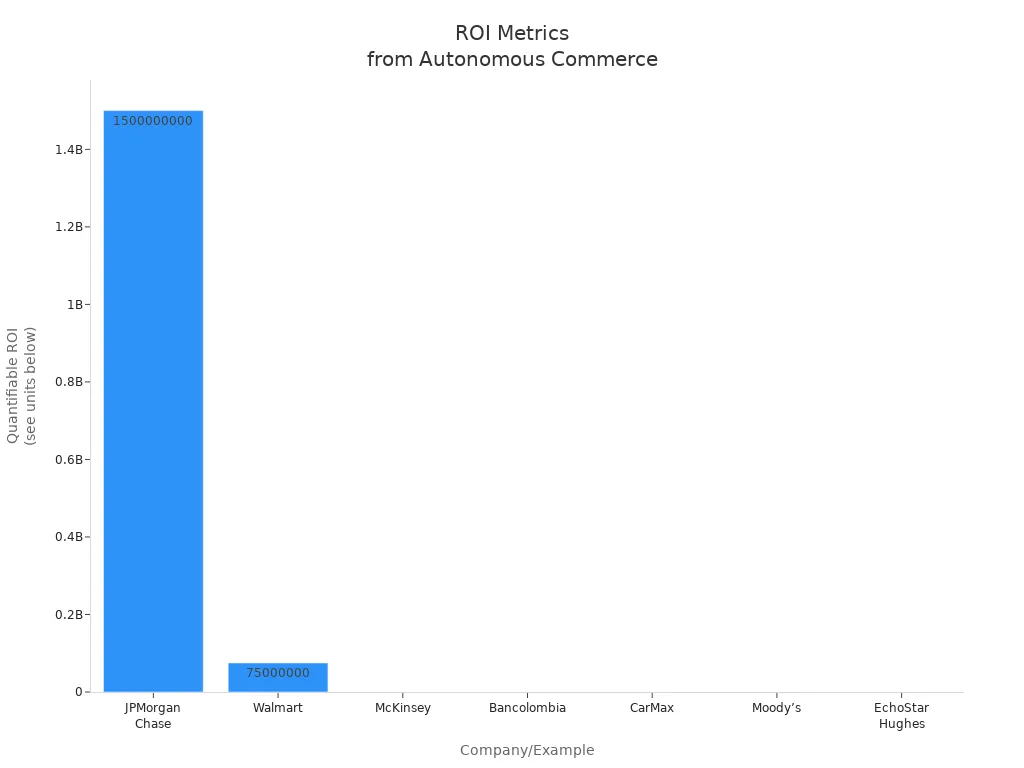
You see that ai delivers strong efficiency and measurable results. These examples show how you can track roi and prove the value of ai in your business.
Overcoming ROI Measurement Challenges
Data Quality and Integration
You may find that measuring ROI in autonomous commerce is not always easy. Many companies struggle with data stored in different places. This makes it hard to get a full picture of your business. Sometimes, product information is not standardized. This can make ROI measurement confusing. You might also face issues when trying to connect old systems with new platforms. Real-time data updates can be tricky, especially during busy times. Security and compliance add more layers of complexity.
| Challenge | Description |
|---|---|
| Data Quality Inconsistencies | Different systems may have data that does not match, leading to errors in ROI calculations. |
| Data Silos | Customer and product data stored separately can block full analysis. |
| API Compatibility Issues | Old and new systems may not work well together, disrupting data flow. |
| Real-time Synchronization | Keeping data updated at all times is hard, especially when business is busy. |
| Security and Compliance | Protecting sensitive data is important, especially in regulated industries. |
| Comprehensive Data Governance | You need strong rules to keep data accurate and aligned across platforms. |
Stakeholder Buy-In
Getting everyone on board with ROI measurement can be tough. Some people worry about data quality or fear big changes to the system. You can help by showing that you have strong data governance and quality checks in place. Explain how your current setup supports a distributed architecture. Talk about risks and how you plan to handle them. Share a clear budget and show how you will protect customer data. Make sure everyone knows how you will manage data across different teams. Training and skill development help teams feel ready for new tools. Define success metrics so everyone knows what to expect.
Actionable Solutions
You can take steps to overcome these challenges. Start by breaking down data silos. Connect your systems so you can see all your data in one place. Standardize product information to make analysis easier. Invest in platforms that support real-time data updates. Focus on strong data governance to keep your data accurate. When you do this, you improve operational efficiency and make ROI measurement more reliable. You also build trust with your team. Clear communication and training help everyone understand the value of autonomous commerce. When you measure ROI well, you can boost operational efficiency and drive better business results.
You can measure autonomous commerce ROI with clear metrics and proven methods. The table below highlights the most actionable metrics:
| Metric | Description | Importance |
|---|---|---|
| Acquisition | Users visit your site | Shows how well you attract people |
| Activation | Users take a key action | Measures first engagement |
| Retention | Users keep coming back | Reflects customer experience |
| Referral | Users bring in new people | Grows your customer base |
| Revenue | Users pay for your service | Tracks profit and growth |
You should also track customer acquisition cost, customer lifetime value, and conversion rate. These help you see how autonomous systems improve customer experience and drive results. Stay open to new benchmarks and trends. Start measuring today to boost your ROI.
FAQ
What is autonomous commerce ROI and why does it matter?
You measure autonomous commerce ROI to see how much value you gain from automation. This helps you track savings, growth, and efficiency. You use these numbers to make smart decisions in ecommerce and b2b ecommerce.
How do you measure ROI in b2b ecommerce?
You track metrics like throughput per employee, win rate uplift, and cost per order reduction. You compare these numbers before and after automation. You use real-time tools to see results in b2b ecommerce and marketing.
What are the main challenges in measuring ROI for ecommerce?
You face issues with data quality, integration, and stakeholder buy-in. You need strong data governance and clear metrics. You must connect systems and standardize information to measure ROI in ecommerce and b2b.
How does cumulative savings equal initial investment in autonomous commerce?
You reach a point where your savings from automation match what you spent. This means your investment pays for itself. You see this in b2b ecommerce, marketing, and ai shopping.
Why is marketing important for b2b ecommerce ROI?
You use marketing to attract and keep customers. You track activation, retention, and referral metrics. You see how marketing drives revenue and improves ROI in ecommerce and b2b ecommerce.
See Also
Understanding Financial Effects of Inventory Movement in 2025
Forecasting Retail Inventory Needs Using Analytics in 2025
Effective Ecommerce Strategies for 2025: A Practical Guide
The Influence of AI Sensors on Fashion Supply Chains in 2025
Revolutionary Technologies Shaping Shipping Processes in 2025