

Autonomous commerce uses AI agents and automation to run buying and selling tasks without human help. You see this shift as companies move from manual work to automated decision-making. Global manufacturers and B2B distributors change how they manage catalogs and sales channels. The market grows fast:
- The market size is expected to reach USD 7.7 billion in 2026.
- It will likely grow from USD 5.7 billion in 2025.
- By 2033, it may hit USD 65.5 billion.
Many organizations adopt AI agents to improve commerce. Here are some key statistics:
| Statistic | Value |
|---|---|
| 79% of organizations report AI agent adoption | 79% |
| 96% plan to expand agentic AI usage in 2026 | 96% |
| 25% of GenAI users launch agentic pilots in 2026 | 25% |
| 43% allocate over half their AI budgets to agentic systems | 43% |
| 88% of executives increase AI budgets for agentic capabilities | 88% |
You can see how automation and AI agents change the way you do business every day.
What Is Autonomous Commerce?
Autonomous Commerce Defined
You see autonomous commerce as a new way to buy and sell. It uses smart technology to make business transactions easy and fast. Leading industry analysts describe autonomous commerce as a transformative method of enterprise purchasing. It mirrors the simplicity of consumer eCommerce. You get automation, intelligent recommendations, and a network of buyers and suppliers. The process feels as simple as shopping online.
You notice a big difference between autonomous commerce and traditional commerce platforms. Traditional platforms require you to do most tasks by hand. You search for products, compare options, and make decisions step by step. Autonomous commerce lets AI agents handle these tasks for you. The system automates the process from start to finish. You save time and reduce errors.
| Execution Type | Traditional Commerce | Autonomous Commerce |
|---|---|---|
| User Involvement | Manual, step-by-step | Autonomous, end-to-end execution |
- In traditional commerce, you perform most tasks manually, including searching for products and making decisions.
- Autonomous commerce employs AI agents that automate these tasks, leading to a more efficient process.
Key Features and Principles
You find several features that set autonomous commerce apart. The system makes decisions in real time. It adapts and learns from every transaction. It runs without stopping, so your business never misses a beat.
| Feature/Principle | Description |
|---|---|
| Autonomous | Decisions on pricing, replenishment, and media are made in real-time by agents without delays. |
| Adaptive | The system learns from every transaction, continuously improving its operations. |
| Always-on | Operations run continuously without interruptions, ensuring a seamless flow of demand, supply, and content. |
You benefit from these features if you manage complex catalogs or sales channels. B2B distributors and manufacturers use autonomous commerce to centralize product data. This reduces manual work and errors. Teams access the same up-to-date information. You see improved searchability and fewer mistakes in pricing and inventory. Customers find products quickly and feel confident in their choices.
| Benefit | Description |
|---|---|
| Centralized Product Data | Reduces manual work and errors, ensuring all teams access the same up-to-date data. |
| Enhanced Customer Experience | Intuitive catalog management allows for personalized experiences, making it easier for customers to find products. |
| Automation | Streamlines processes, enabling quick responses to market changes and new SKUs. |
| Improved Searchability | A well-managed catalog helps customers find products quickly and easily. |
| Reduced Errors | Centralized systems minimize costly mistakes in pricing and inventory. |
| Enhanced Customer Confidence | Clear product information leads to better purchasing decisions. |
- Centralized product data infrastructure helps you keep information accurate.
- Structured taxonomy and metadata make catalogs easy to use.
- Content excellence improves customer trust.
- Automation and workflow optimization let you respond quickly to new demands.
Tip: You can use autonomous commerce to simplify catalog management and boost customer satisfaction. This approach helps you stay competitive in a fast-changing market.
How Autonomous Commerce Works

Automation and AI Agents
You see ai agents at the heart of autonomous commerce. These smart systems handle tasks that once needed people. They make decisions, manage inventory, and complete transactions with little human help. You find different types of ai agents working together:
| AI Agent Type | Functionality Description |
|---|---|
| AI-powered agents | Make decisions, manage tasks, and complete transactions with minimal human intervention. |
| Inventory management agents | Handle inventory tasks and optimize stock levels autonomously. |
| Shopping assistants | Help you find and buy products quickly and easily. |
| AI shopping concierge | Manage your entire purchase journey, from adding items to your cart to checking out. |
You notice that ai agents can also run marketing campaigns, compare products, and even negotiate deals. Major retailers now use ai agents to handle full purchase journeys. For example, Google Shopping uses Gemini’s agentic features to add items to your cart and finish checkout for you.
Sensing, Deciding, and Executing
You watch as autonomous commerce systems sense, decide, and execute. First, ai agents sense what is happening by collecting data from orders, inventory, and the market. Next, they decide what actions to take by using machine learning models. Finally, they execute tasks like updating product content or answering customer questions.
- Sensing: ai agents monitor market trends and gather data.
- Deciding: They analyze the data and choose the best action.
- Executing: The system acts on these decisions, often without human help.
You see this process in many areas, such as customer support, SEO, creative work, and logistics. This approach brings full automation to business operations.
Self-Running Workflows
You benefit from self-running workflows in autonomous commerce. These workflows let ai agents manage tasks from start to finish. For example, ai agents can scan emails and tickets, understand requests, and act on them without waiting for people to step in. You also see ai agents monitoring inventory and starting new orders when stock runs low. They can negotiate terms, process payments, and update records in real time.
Note: With full automation, you get faster order processing, fewer mistakes, and more time to focus on growth.
You experience a world where autonomous systems handle sales execution, manage quotes, and keep your business running smoothly. Autonomous commerce gives you the tools to compete and succeed in a fast-changing market.
Why Now? Drivers of Autonomous Commerce
Technology Advances
You see rapid changes in technology making autonomous systems possible. AI systems now make buying decisions and finish transactions with little human help. Voice assistants and smart apps can handle your shopping tasks on their own. Machine learning algorithms study huge amounts of data to predict what you need and keep products in stock. Complex neural networks help these systems learn and improve in real time. Autonomous value chains now create networks that run with almost no human oversight. These systems predict, adapt, and optimize themselves.
- AI systems make decisions and complete purchases.
- Voice assistants and smart apps handle tasks for you.
- Machine learning predicts demand and manages inventory.
- Autonomous value chains run with little human input.
| Evidence Type | Description |
|---|---|
| Customer Preference | Nearly 70% of shoppers prefer personalized recommendations, driving retailers to adopt machine learning. |
| Inventory Management | Predictive systems have led to over 20% fewer stockouts, improving product availability. |
| Market Share | The software segment accounted for 56.4% of the machine learning market in retail in 2025, indicating strong reliance on analytics and AI applications. |
Market and Consumer Demands
You notice that shoppers want faster, safer, and more personal experiences. Many people trust automated systems for safety. For example, 47% of global consumers believe automated systems are safer than human drivers. Autonomous systems can reduce crashes by up to 49%. At the same time, 70% of consumers worry about cybersecurity risks, and 68% feel unsure about how these systems handle rare problems. Younger shoppers want smart displays and AI assistants. Many people prefer shared autonomous services over traditional options.
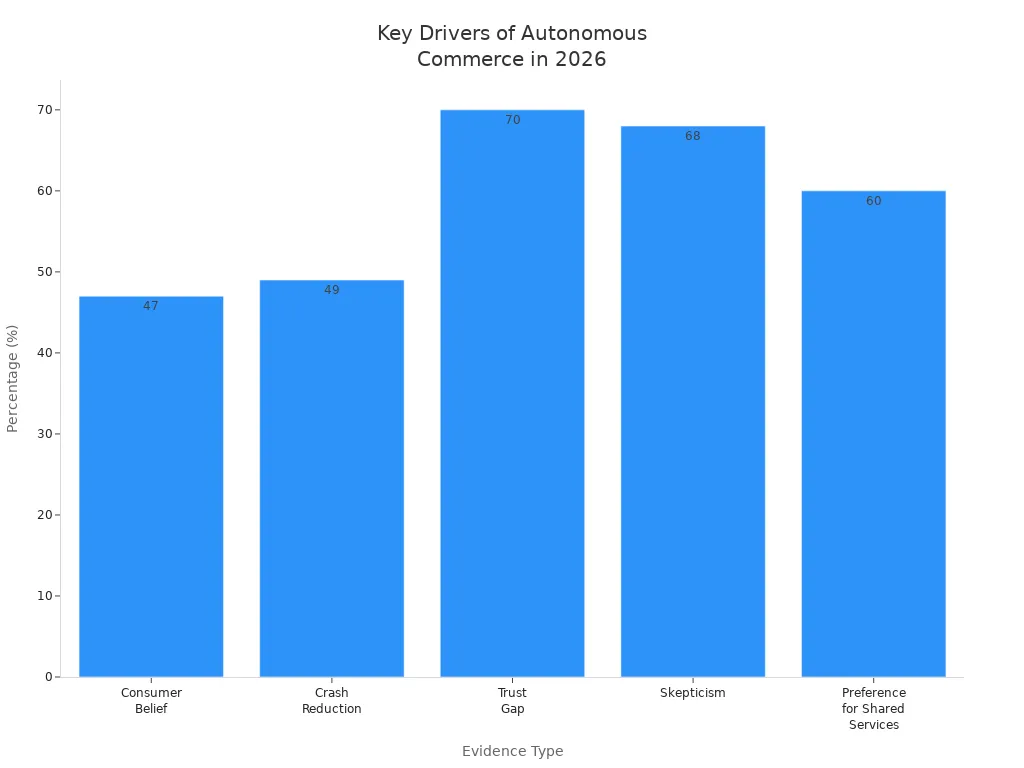
You see that 69% of people want agentic help with subscriptions and grocery shopping. Over half of users like checking out with AI in apps or on their phones. Consumers now trust AI with important tasks, but they want clear rules and strong data protection.
Regulatory and Ethical Factors
You must follow new rules as governments respond to autonomous technology. Laws like the SELF DRIVE Act set safety standards and create data rules for autonomous vehicles. Some changes make it easier for companies to launch new models. Geopolitical tensions, such as those between the U.S. and China, also shape the rules for autonomous systems. You need to think about ethics, too. You must protect customer data, prevent job loss, and make sure AI treats everyone fairly. Companies now use data encryption, retraining programs, and bias testing to meet these goals.
Note: You should always check for new laws and best practices to keep your autonomous commerce solutions safe and fair.
Impact on Business and Consumers
Business Benefits and Challenges
You gain many advantages when you adopt autonomous systems in your business. These platforms help you automate key processes, improve customer experience, and drive business growth. The table below shows some main benefits:
| Benefit | Description |
|---|---|
| Improved Customer Experience | Enhances online shopping by personalizing recommendations and offers based on customer preferences. |
| Competitive Advantage | Enables faster and more efficient services, helping businesses outperform competitors. |
| Automation of Key Processes | Automates tasks like inventory management and order processing, saving time and reducing costs. |
| Business Growth | Facilitates expansion by allowing companies to focus on innovation while core processes are automated. |
You may also face challenges as you move to autonomous models:
- Architectural friction from old systems can slow down progress.
- Data readiness is a problem for 58% of retailers, as inconsistent data makes it hard for AI agents to work well.
- Security and trust issues require strong protection and clear communication.
Consumer Experience
You notice a big change in how you shop with autonomous platforms. These systems reduce manual effort and make shopping faster. The table below compares traditional and autonomous commerce:
| Feature | Traditional Commerce | Autonomous Commerce |
|---|---|---|
| Manual Effort | Requires active navigation | Minimal human intervention, AI handles complexity |
| Efficiency | Time-consuming browsing | Rapid analysis of options in seconds |
| Personalization | Based on past purchases | Context-aware, anticipates needs |
You spend less time on research, and you can consider more vendors. In fact, 28% of business buyers using generative AI report spending less time on research, and 57% consider more vendors. These systems can understand your needs and make tailored recommendations. However, you may miss the joy of browsing or worry about losing control over purchases.
Data, Trust, and Security
You want to know your data stays safe with autonomous platforms. Companies use advanced encryption, follow strict regulations, and run regular audits to protect your information. They also share clear data policies with you. Still, you may worry about data being collected or used without your consent. Problems like data leaks, hacking, or bias can happen. If you feel your data is not secure, you may stop using a platform. Over 80% of consumers would leave an e-commerce site if they felt their data was at risk. You should always look for platforms that explain how they protect your data and respect your privacy.
Future Trends in Autonomous Commerce
Evolving AI Agents
You will see AI agents become much smarter and more independent by 2026. These agents will move beyond simple tools and start reasoning and solving complex tasks on their own. This change will bring real-time, adaptive operations to your business. Multi-agent systems will work together, making fewer mistakes and finishing tasks faster. For example, retailers have seen a huge jump in traffic to AI-powered answer engines, while old search methods are losing popularity. Companies using these advanced systems report up to 60% fewer errors and 40% faster execution.
You will notice that AI agents can now manage entire shopping journeys. They help you discover products, compare options, and even negotiate prices. In retail, these agents often outperform humans by making quick and accurate decisions. Connected vehicles can spot maintenance needs, schedule repairs, order parts, and handle payments without anyone stepping in. Manufacturing systems can detect when supplies run low, place orders, and manage deliveries automatically. This shift will change how you shop and work, as customer AI agents start making choices based on your needs instead of brand loyalty. Many experts believe that agentic AI will reshape the workplace more than the Internet did.
Tip: Stay curious about how these agents can help you save time and make better decisions.
Preparing for Change
You need to get ready for the rise of autonomous commerce. Start by building a strong leadership team that shares a clear vision. Check your data systems to find any gaps. Set up rules for how AI should work and manage risks. Begin with small projects that automate simple sales tasks. Involve your sales teams early, explain new roles, and offer training.
A strong data foundation is key. Make sure your data is accurate and up to date. Good data helps AI understand what customers want. Keep your data clean and organized so AI agents can work well. You should also encourage your team to keep learning. Use new learning tools and create a culture that values growth. Organize work around skills, not just job titles. This flexible approach helps your business adapt quickly when things change.
Here are some steps you can follow:
- Build a cross-functional leadership team.
- Audit your data infrastructure.
- Create governance principles for AI.
- Launch pilot automation projects.
- Train and support your teams.
Note: Adapting to autonomous systems means staying flexible and open to new ways of working. This will help you succeed as technology keeps changing.
You see autonomous commerce as a game-changer for business. AI-driven systems boost efficiency, improve personalization, and give you a competitive edge. Companies now process orders faster and keep customers happy. To get started, you can:
- Audit your data and improve product details.
- Build strong API connections.
- Create flexible business policies.
- Invest in your own AI tools.
Keep learning new skills and encourage your team to adapt. This helps your business stay ahead as technology keeps changing.
FAQ
What is the main difference between autonomous commerce and traditional ecommerce?
You let AI agents handle tasks in autonomous commerce. In traditional ecommerce, you do most things yourself. Autonomous systems make decisions, manage orders, and update information without your help.
How do personal ai shopping managers help you?
You use personal ai shopping managers to find products, compare prices, and complete purchases. These managers learn your preferences and make shopping easier and faster.
Is my data safe with autonomous commerce platforms?
You can expect strong security. Companies use encryption and regular audits to protect your data. Always check privacy policies and choose platforms that explain how they keep your information safe.
Will autonomous commerce replace human jobs?
You may see some jobs change or shift. Many businesses retrain workers for new roles. People still guide AI systems and handle tasks that need creativity or personal touch.
Can small businesses use autonomous commerce?
You can use autonomous commerce even if you run a small business. Many platforms offer tools that help you automate tasks, manage inventory, and improve customer service.
See Also
Strategic Ecommerce Solutions for 2025: A Practical Guide
The Evolution of Ecommerce Services in the Coming Years
Enhancing Productivity with Pick to Cart Solutions in 2025
Revolutionary Technologies Shaping Shipping Processes for 2025