
You can find the best ai erp platforms for manufacturing among Oracle Fusion Cloud SCM, SAP S/4HANA Manufacturing, Microsoft Dynamics 365 Supply Chain Management, Infor CloudSuite Industrial, Epicor Kinetic, IFS Cloud, QAD Adaptive, Sage X3, Acumatica, and NetSuite. Manufacturers now lead in adopting manufacturing erp solutions, holding nearly 20% of ERP market revenue. AI-driven ERP brings faster decision-making, lower costs, and real-time insights. When you compare options, look for industry-specific features, scalability, AI capabilities, user experience, and return on investment.
- Manufacturing is the largest adopter of ERP solutions, with 47% of companies seeking these systems.
Quick Comparison of Best AI ERP Platforms
Top Platforms Overview
You have many choices when you look for the best ai erp platforms for manufacturing. Each platform offers unique strengths for different business sizes and needs. The table below gives you a quick look at the top ai erp platforms, their core features, and how they use AI to improve supply chain visibility and operations.
| Platform | Core Features | AI Capabilities | Target Manufacturer Size | Pricing Approach |
|---|---|---|---|---|
| Oracle Fusion Cloud SCM | Automation, predictive analytics, financial transformation | Embedded AI, generative AI, predictive analytics | Mid to Large | Subscription, custom quote |
| SAP S/4HANA Manufacturing | Integrated planning, operational integration, analytics-driven processes | AI for planning, operational integration | Large | $200+/user/month + implementation |
| Microsoft Dynamics 365 SCM | Personalization, proactive insights, Power BI integration | User-friendly AI, Copilot, workflow automation | Mid to Large | $175/user/month + implementation |
| Infor CloudSuite Industrial | Cloud ERP, supply chain management, role-based AI agents | Role-based AI, sustainability reporting | Mid to Large | $150/user/month + implementation |
| Epicor Kinetic | Industry-specific ERP, real-time analytics, supply chain tools | AI-driven apps, analytics | Small to Mid | $125/user/month + implementation |
| IFS Cloud | Asset management, project management, service management | Predictive maintenance, AI-driven insights | Mid to Large | Subscription, custom quote |
| QAD Adaptive | Adaptive ERP, supply chain, analytics | AI for adaptive planning | Mid to Large | Subscription, custom quote |
| Sage X3 | Financials, production, inventory, analytics | Basic AI, process automation | Small to Mid | $75/user/month + implementation |
| Acumatica | Cloud ERP, project accounting, manufacturing management | AI for reporting and automation | Small to Mid | $2,000-$4,000/month |
| NetSuite | Financials, CRM, supply chain, analytics | AI for automation, predictive analytics | Small to Large | $2,499/month + $129/user/month |
Tip: You should compare platforms based on your company size, industry needs, and the level of AI automation you want.
Key Evaluation Criteria
When you compare ai erp platforms, focus on these key criteria:
- Core Features: Look for supply chain visibility, automation, analytics, and industry-specific tools.
- AI Capabilities: Check if the platform uses AI for predictive analytics, workflow automation, or generative tasks.
- Target Manufacturer Size: Some platforms fit small businesses, while others serve large enterprises.
- Pricing Approach: Most platforms use a subscription model, but costs can vary based on users and implementation.
You can use this overview to narrow your choices and find the platform that matches your business goals.
Why AI Matters in Manufacturing ERP

Manufacturing ERP Benefits with AI
You see big changes when you use AI in manufacturing erp. AI erp platforms help you work faster and smarter. They automate tasks like invoice matching and payroll reconciliation. This means you spend less time on paperwork and more time on production. You also get better demand forecasting because AI looks at sales trends and market signals. This helps you avoid extra inventory and waste.
- AI automates repetitive tasks, making your operations leaner.
- Predictive maintenance models spot problems before machines break down, saving you time and money.
- Real-time quality control checks products as they are made, so you catch defects early.
- AI-powered demand forecasting uses past sales and outside factors to help you plan better.
- Robotic Process Automation increases speed and reduces mistakes.
When you use AI-driven manufacturing erp, you can improve demand accuracy by up to 50%. You also cut downtime and lower costs with predictive maintenance.
Essential AI Features for Manufacturers
You need the right AI features to get the most from your manufacturing erp. Look for platforms that offer real-time analytics and strong integration and scalability. These features help you grow and connect all your systems. AI capabilities and customization let you adjust workflows to fit your needs. User experience and support make it easy for your team to use the system every day.
Here are the top AI features you should look for:
- Predictive analytics to help you plan and make smart decisions
- Intelligent automation for routine tasks
- Conversational AI, like chatbots, for easy help
- AI agents that manage business processes and let you customize workflows
- Real-time production monitoring for instant feedback
- IoT integration to connect machines and get live data
With these tools, you can boost productivity, reduce errors, and keep your operations running smoothly.
Detailed Review of Leading AI ERP Platforms
Oracle Fusion Cloud SCM
Oracle Fusion Cloud SCM gives you a powerful set of ai erp platforms tools for manufacturing. You can use embedded AI agents to automate inventory management, speed up contract reviews, and improve logistics. The platform supports real-time analytics and helps you make quick decisions. You will find unique features like the Operator Workbench and Manufacturer Onboarding Advisor. These tools help you manage production and supplier relationships with ease.
| AI Functionality | Description | Benefits |
|---|---|---|
| Component Replacement Assistant | Helps you find alternative parts quickly and supports fast change orders. | Reduces disruption and speeds up changes. |
| Planning Cycle Assistant | Automates order release and improves scheduling. | Quicker decisions and better schedule stability. |
| AI-driven contract review | Simplifies supplier and negotiation management. | Shorter cycle times and more consistent results. |
| Inventory Management AI Agents | Automates allocation and highlights risks. | Faster issue resolution and better inventory. |
| Redwood interfaces in Logistics | Improves logistics responsiveness and navigation. | Faster decisions and improved throughput. |
You can use Oracle Fusion Cloud SCM in many industries:
| Industry | Description |
|---|---|
| Automotive | Works well for car and parts manufacturers. |
| High tech | Supports electronics and technology companies. |
| Life sciences | Helps medical and biotech manufacturers. |
| Aerospace and defense | Fits companies in aerospace and defense. |
| Consumer goods | Good for makers of everyday products. |
Strengths:
- Advanced AI capabilities and customization for supply chain and production.
- Strong integration and scalability for large operations.
- Excellent user experience and support.
Weaknesses:
- Pricing can be high for smaller manufacturers.
- Implementation may take time for complex businesses.
Tip: If you work in a complex industry and need deep AI features, Oracle Fusion Cloud SCM gives you the tools to stay ahead.
SAP S/4HANA Manufacturing
SAP S/4HANA Manufacturing uses AI to help you optimize production. The platform analyzes real-time data from factory sensors to find ways to improve. You can spot bottlenecks and get recommendations to fix them. SAP S/4HANA also helps you track resource use and reduce your carbon footprint. You can make better decisions about resource allocation and cut costs.
- Embedded AI works in real time, giving you instant support in your daily tasks.
- You get better efficiency in finance, supply chain, and customer management.
| Strengths | Weaknesses |
|---|---|
| Superior quality management capabilities | High implementation costs |
| Advanced procurement features | Long migration times (18-24+ months) |
| Effective production planning and scheduling | Limited flexibility in RISE contracts (multi-year terms) |
SAP S/4HANA Manufacturing fits large manufacturers who need strong quality control and advanced planning.
Note: You should choose SAP S/4HANA if you want deep AI integration and can invest in a long-term solution.
Microsoft Dynamics 365 Supply Chain Management
Microsoft Dynamics 365 Supply Chain Management gives you a flexible cloud-native erp solution. You can use AI to personalize workflows and automate tasks. The platform connects with Power BI for real-time analytics. You get proactive insights and can use Copilot to help with daily operations.
Strengths:
- Easy to use and quick to deploy.
- Good for mid-sized and large manufacturers.
- Strong integration with Microsoft tools.
Weaknesses:
- Some advanced AI features may require extra setup.
- Costs can rise with more users and modules.
You should consider this platform if you want a familiar interface and strong analytics.
Infor CloudSuite Industrial
Infor CloudSuite Industrial offers you a cloud-based ERP with role-based AI agents. You can manage your supply chain and track sustainability. The platform supports integration and scalability, so you can grow your business without switching systems.
Strengths:
- Role-based AI helps you automate tasks for different jobs.
- Good sustainability reporting tools.
- Works well for mid-sized and large manufacturers.
Weaknesses:
- Customization can be complex.
- Some users report a learning curve.
Infor CloudSuite Industrial fits companies that want flexible AI tools and strong supply chain management.
Epicor Kinetic
Epicor Kinetic focuses on industry-specific needs. You get AI-powered automation and real-time analytics. The platform helps you integrate data from different systems and track sustainability metrics.
| Use Case | Description |
|---|---|
| AI-Powered Automation | Lets you run intelligent operations at scale. |
| Enhanced Data Integration | Brings together data for faster insights. |
| Sustainability Metrics | Helps you track and improve your environmental impact. |
Strengths:
- Easy to use for small and mid-sized manufacturers.
- Good for companies with unique industry needs.
Weaknesses:
- May lack some advanced features for very large enterprises.
- Customization options can be limited.
Epicor Kinetic works best if you want fast setup and strong automation.
IFS Cloud
IFS Cloud gives you advanced AI features for manufacturing. You can use predictive maintenance to spot equipment problems before they happen. Intelligent scheduling helps you use your resources better. The IFS.ai tool lets you automate content and processes.
| AI Feature | Description |
|---|---|
| Predictive Maintenance | Finds equipment issues before they cause downtime. |
| Intelligent Scheduling | Makes resource use more efficient. |
| IFS.ai | Automates content and business processes. |
| Predictive and Prescriptive Analytics | Improves decision-making and performance. |
Strengths:
- Strong predictive maintenance and scheduling.
- Good for asset-intensive industries.
Weaknesses:
- Pricing is custom and may be high for smaller companies.
- Some features may require extra training.
IFS Cloud fits mid-sized and large manufacturers who want advanced AI and automation.
QAD Adaptive
QAD Adaptive uses AI to help you make better decisions. You can use predictive analytics to spot risks like supply chain disruptions. The platform gives you real-time data, so you can see trends and act fast. As AI improves, QAD Adaptive will give you more recommendations to help you adapt to market changes.
Strengths:
- Good for companies that need to react quickly to changes.
- Strong real-time analytics and decision support.
Weaknesses:
- May not have as many industry-specific features as some competitors.
- Custom pricing can make budgeting harder.
QAD Adaptive works well for mid-sized and large manufacturers who want flexible AI tools.
Sage X3
Sage X3 helps you manage multiple companies and regions. You can use intercompany features and share products and partners. The platform supports multiple ledgers and consolidated financials.
| Advantages | Disadvantages |
|---|---|
| Intercompany features for global business. | May need extra licenses, raising costs. |
| Supports multiple ledgers and consolidations. | Not all regions work well together, causing compliance issues. |
| Shares products and partners for synergy. | Technical setup can be complex. |
Strengths:
- Good for small and mid-sized manufacturers with global needs.
- Helps you manage complex financials.
Weaknesses:
- Costs can rise with more licenses.
- Deployment may be tricky for some users.
Sage X3 fits companies that need to manage many entities and regions.
Acumatica
Acumatica gives you a cloud-native erp with strong AI features. You can use AI anomaly detection to find cost and efficiency problems. The platform helps you track inventory and production with lot and serial tracking. You can also streamline bill of materials cost rollups and improve production scheduling.
| Feature | Description |
|---|---|
| AI Anomaly Detection | Spots cost and efficiency issues. |
| Lot/Serial Tracking | Tracks inventory and production items. |
| Streamlined BOM Rollups | Makes bill of materials costing easier. |
| Improved Scheduling | Optimizes manufacturing schedules. |
You can automate routine tasks and make your operations faster. Acumatica works well for small and mid-sized manufacturers who want easy integration and scalability.
NetSuite
NetSuite uses AI to help you manage your supply chain and production. You can forecast demand, manage inventory, and reduce costs. The platform helps you customize orders and spot inefficiencies. NetSuite also supports workforce training with AI-driven simulations and improves safety by monitoring work environments.
- You can design products quickly and plan maintenance before problems happen.
- NetSuite fits small to large manufacturers who want flexible AI tools and strong user experience and support.
Tip: NetSuite is a good choice if you want a platform that grows with your business and supports many types of manufacturing.
Comparing Strengths, Weaknesses, and Use Cases
Platform Strengths and Weaknesses
When you choose an ERP system, you want to know what works best for your business size. Each platform has its own strengths and weaknesses. Here is a quick look at how some top options compare:
| Product | Pros | Cons | Best For |
|---|---|---|---|
| Infor | Industry-specific, strong analytics | Needs big change effort | Medium to large manufacturers |
| Bista Solutions | Odoo experts, full ERP, automation | Can overwhelm small firms | Odoo-led transformation |
| Odoo | Modular, open-source, customizable | Hard for beginners | Flexible, growing businesses |
You see that SAP Business One and Infor SyteLine fit smaller manufacturers. Large companies often pick Oracle Fusion Cloud ERP, but it can be expensive. If you run a mid-sized business, Epicor and Infor CloudSuite give you strong production tools. Acumatica helps you with machine learning for expenses and inventory. NetSuite gives you built-in AI for reports and forecasts. Microsoft Dynamics 365 lets you use natural language for financial questions and works well with other Microsoft tools.
Tip: Always match the platform to your company’s size and needs. This helps you avoid high costs or missing features.
Unique AI Features and Real-World Applications
You can see the power of unique AI features in real-world examples. LG Electronics uses AI in its ERP to manage global supply chains. This helps them forecast better and cut waste. Boeing uses predictive analytics in its ERP to spot possible failures in aircraft. This keeps planes safer and reduces downtime. Samsung Electronics uses AI-driven ERP to automate assembly and check for defects in real time. This improves quality and saves time.
- Acumatica uses machine learning to classify expenses and predict inventory needs.
- SAP S/4HANA has embedded machine learning and predictive MRP for inventory.
- Epicor and Plex Systems help you forecast demand and optimize production.
These examples show how manufacturing erp with AI can make your business more efficient, safe, and ready for the future.
Pricing and Suitability Matrix
Pricing Comparison
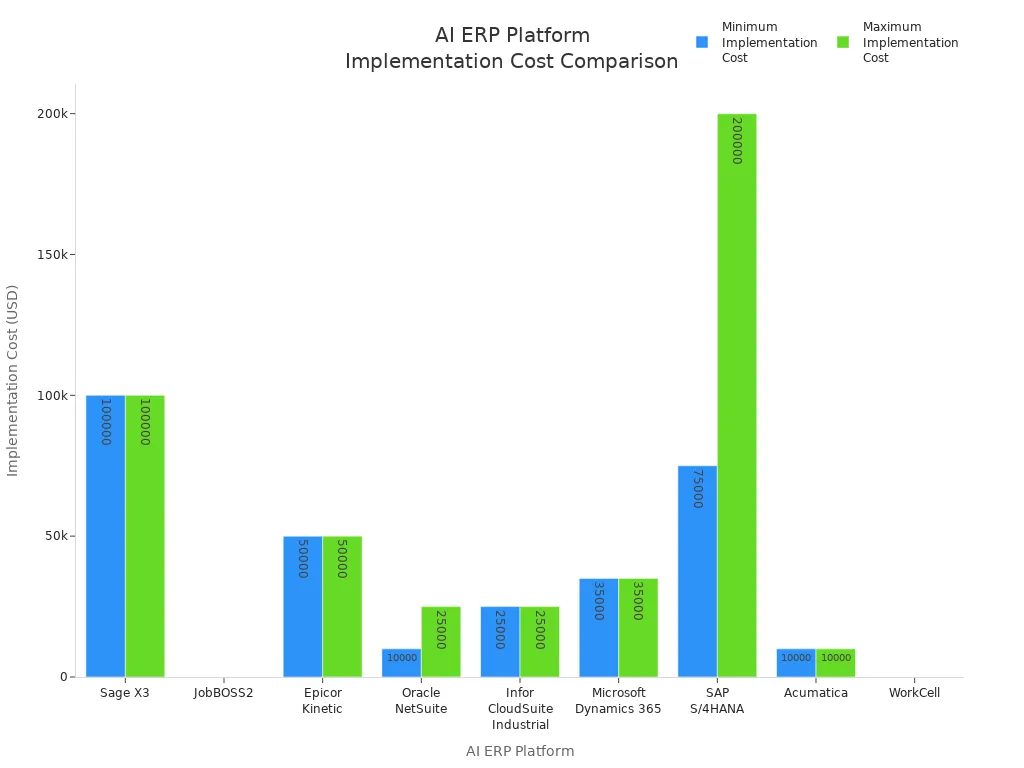
You need to understand the cost and roi before choosing an ERP platform. Pricing varies based on features, company size, and implementation needs. Most platforms use a subscription model, but you also pay for setup and customization. The table below shows average implementation costs and monthly fees for leading solutions.
| AI ERP Platform | Average Implementation Cost | Subscription Fees |
|---|---|---|
| Sage X3 | Starting at $100,000 | $75/user/month |
| Epicor Kinetic | Starting at $50,000 | $125/user/month |
| Oracle NetSuite | $10,000 - $25,000 | $2,499/month + $129/user/month |
| Infor CloudSuite Industrial | Starting at $25,000 | $150/user/month |
| Microsoft Dynamics 365 | Starting at $35,000 | $175/user/month |
| SAP S/4HANA | Starting at $75,000, often > $200,000 | $200+/user/month |
| Acumatica | Around $10,000 | $2,000 - $4,000/month |
Tip: You should compare both upfront and ongoing costs to find the best value for your business.
Best Fit by Manufacturer Type
You want a platform that matches your company’s needs. Some solutions work better for small businesses, while others fit large or asset-intensive manufacturers. Here is a quick guide to help you choose:
| Platform | Best Fit Manufacturer Type | Key Features |
|---|---|---|
| Sage X3 | Small to mid-sized | Global management, financials |
| Epicor Kinetic | Small to mid-sized, asset-intensive | Delivery optimization, automation |
| Oracle NetSuite | Small to large | Customization, forecasting |
| Infor CloudSuite Industrial | Mid-sized, asset-intensive | Predictive maintenance, data management |
| Microsoft Dynamics 365 | Mid-sized to large | Integration, analytics |
| SAP S/4HANA | Large | Advanced planning, quality control |
| Acumatica | Small to mid-sized | Inventory tracking, scheduling |
- Infor CloudSuite Industrial helps asset-intensive manufacturers save money and keep production lines running smoothly.
- Epicor Kinetic improves efficiency for mid-sized companies with delivery optimization and task automation.
- Oracle Fusion Cloud SCM enhances decision-making speed and supply chain efficiency for larger operations.
If you run a mid-market manufacturing erp, you may find Epicor Kinetic or Infor CloudSuite Industrial offer the right mix of features and pricing. You can use these options to scale your business and boost productivity.
Note: Always match the platform to your company size and industry needs. This ensures you get the best return on investment.
Choosing the Right Manufacturing ERP
Matching AI ERP Platforms to Business Needs
You want to choose an ERP system that fits your business. Every manufacturer has different needs. Some companies need strong supply chain tools. Others want better automation or easy integration with current systems. You should look at several important factors before you decide.
Here is a table to help you compare what matters most:
| Factor | Description |
|---|---|
| Industry-Specific Features | Essential for managing production, inventory, and supply chain effectively. |
| Integration and Scalability | Must seamlessly integrate with existing systems and grow with the business. |
| AI Capabilities | Includes predictive analytics, machine learning, and automation tools for efficiency. |
| User Experience and Support | Intuitive interfaces and strong support enhance usability. |
| Cost and ROI | Important to evaluate the financial impact and return on investment. |
You should match your needs to these factors. For example, if you work in a fast-changing industry, you may want strong AI capabilities and easy integration. If your company plans to grow, scalability matters. Always check the user experience and support, so your team can use the system with confidence.
Key Implementation Considerations
When you start using a new ERP, you need a clear plan. You should set goals for what you want to achieve. Make sure your team understands the changes. Training helps everyone use the new system well. You also need to check if your data is ready to move into the new platform.
Here are some steps to help you succeed:
- List your main business goals.
- Choose a project leader for the ERP rollout.
- Plan for staff training and support.
- Test the system before you go live.
- Review your progress after launch.
Tip: Always look at cost and roi before you make your final choice. This helps you see if the new system will give you the value you expect.
You can find the right ERP platform by matching your goals, company size, and budget. Large manufacturers often choose SAP S/4HANA or Oracle Fusion Cloud SCM for advanced AI and planning. Mid-sized companies may prefer Epicor Kinetic or Infor CloudSuite Industrial for automation and flexibility. Small businesses often select Acumatica or Sage X3 for cost and ease of use.
- Align your platform with your business needs and growth plans.
- Clean and unify your data for reliable results.
- Involve your team and plan for integration.
- Start with pilot projects to measure value.
You set your business up for success when you focus on practical AI features and clear objectives.
FAQ
What is an AI ERP platform?
An AI ERP platform uses artificial intelligence to help you manage business tasks. You can automate work, get real-time data, and make better decisions. These systems help you save time and reduce mistakes.
How does AI improve manufacturing ERP?
AI helps you spot problems early, predict machine failures, and plan production. You can use AI to track inventory and improve quality. This means you work faster and waste less.
Which AI ERP is best for small manufacturers?
You may find Acumatica or Sage X3 fit small manufacturers well. These platforms offer easy setup, lower costs, and strong support. You can scale as your business grows.
How long does ERP implementation take?
Most ERP projects take several months. Small companies may finish in three to six months. Large businesses may need a year or more. You should plan for training and testing.
See Also
Why WarpDriven ERP Is Essential for Smart Supply Chain Management
Using AI to Improve Production Forecasting in 2024
How AI Accelerates Market Entry by Shortening Lead Times
Capacity Planning for Brands Enhanced by AI Technology
Top 10 E-commerce Platforms with Seamless Accounting Integration