

Imagine you want to show your team that automation brings real value. You need to prove the roi of ecommerce with clear numbers and facts. Stakeholders look for proof before they trust new tools. You can share that most companies see results quickly.
- 76% of eCommerce companies report a positive ROI within the first year after using automation solutions.
When you use data, you help everyone understand the impact and make better decisions.
Understanding ROI of eCommerce Automation

What ROI Means in eCommerce Automation
You need to know what ROI means before you can measure it. In eCommerce automation, ROI stands for the value your business gains compared to what you spend on automation tools and processes. You calculate ROI by subtracting the cost of automation from the gains it brings, then dividing that number by the cost and multiplying by 100. This formula helps you see the percentage return on your investment. ROI of ecommerce is not just about money. You also need to look at how automation saves time, reduces mistakes, and makes customers happier. For example, when you use automation, you can process orders faster and cut down on manual work. You also get better results from marketing campaigns and see more sales. These improvements show up as both financial gains and smoother operations.
Why ROI Matters for Stakeholders
Stakeholders want proof that your investment in automation works. They look for clear benefits that help the business grow. ROI of ecommerce gives you a way to show these results. You can use a table to explain the main benefits:
| Benefit | Description |
|---|---|
| Improved Profitability | You see higher profit margins when you use automation. |
| Reduced Operational Costs | Automation lowers costs by making processes faster and cutting manual work. |
| Enhanced Operational Efficiency | Teams can focus on important tasks instead of routine work. |
| Better Customer Satisfaction | Customers get faster service and more personal communication, which builds loyalty. |
You also get other advantages:
- You can react quickly to changes in the market.
- You can update prices and campaigns automatically.
- You see better conversion rates and keep customers coming back.
Most eCommerce businesses see a positive ROI in a short time. For example, some brands recover their investment in as little as 32 days. When you show these facts, you help stakeholders trust your decisions and support new projects.
How to Measure ROI of eCommerce Automation

Establishing a Baseline
You need a clear starting point before you can measure the roi of ecommerce. Setting a baseline helps you see how your business performs before you start order automation. Follow these steps to build a strong foundation:
- Set clear goals for your automation project. Use the SMART method. Make your goals Specific, Measurable, Achievable, Relevant, and Time-bound.
- Gather data on your current performance. Look at costs, how long tasks take, and how often mistakes happen.
- Find all the data sources that show how your processes work. Make sure you collect data from the right places.
- Check your data for accuracy. Use validation checks to keep your numbers reliable.
- Standardize how you collect data. Train your team so everyone follows the same steps.
You can use a table to track the most common metrics before you start order automation:
| Metric | Description |
|---|---|
| Total sales volume | Measures the overall revenue generated. |
| Conversion rate | Shows the percentage of visitors who buy something. |
| Average order size | Reflects the average value of each sale. |
| Repeat purchase rate | Shows how many customers buy again. |
| Order processing time | Time taken to process an order. |
| Shipping speed | Measures how quickly orders are delivered. |
| Error rates | Tracks mistakes in order fulfillment. |
Tip: Collect at least four weeks of data before you start automation. This gives you a solid comparison point for measuring automation roi.
Selecting Key Metrics and KPIs
You need to choose the right metrics to measure the success of order automation. Focus on KPIs that matter most to your business. Leading companies pick metrics that show how customers feel and how the business grows. This helps you improve profit and gross margin faster than your competitors.
Here are some important KPIs for order automation:
| KPI | Description |
|---|---|
| Conversion Rate (CR) | Ratio of targets achieved to the number of visitors. |
| Average Order Value (AOV) | Average amount spent by customers per transaction. |
| Customer Lifetime Value (CLV) | Total revenue expected from a customer over their relationship. |
| Cart Abandonment Rate (CAR) | How often customers leave without buying. |
| Customer Acquisition Cost (CAC) | Cost of getting a new customer, including marketing and sales. |
| Bounce Rate (BR) | How many visitors leave the website quickly. |
| Click-through Rate (CTR) | Ratio of ad clicks to ad views. |
| Time on Site (TOS) | How long a visitor spends on your website. |
| Rate of Return (RoR) | How many products customers return after buying. |
| Traffic Source | Where your visitors come from, which helps you see which marketing works best. |
You should set targets for each KPI. Track them over time to spot trends and fix problems early. Most dashboard tools help you see these numbers in one place. This makes it easier for you and your team to make smart decisions.
Calculating Automation Costs
To prove the roi of ecommerce, you must know how much you spend on order automation. Start by listing all costs:
- Software and platform fees
- Setup and integration expenses
- Training for your team
- Ongoing support and updates
Add these costs together to get your total investment. Compare this number to your cost to serve before and after automation. This shows you the real impact on your business.
Order automation often leads to big cost savings. For example, coordinated robotic workflows can cut error rates to 1.5%. This means fewer mistakes and less money lost. One company saved $250,000 in a year by reducing errors in order automation. You also save on labor costs because robots handle routine tasks. Your team can focus on more important work, which boosts productivity.
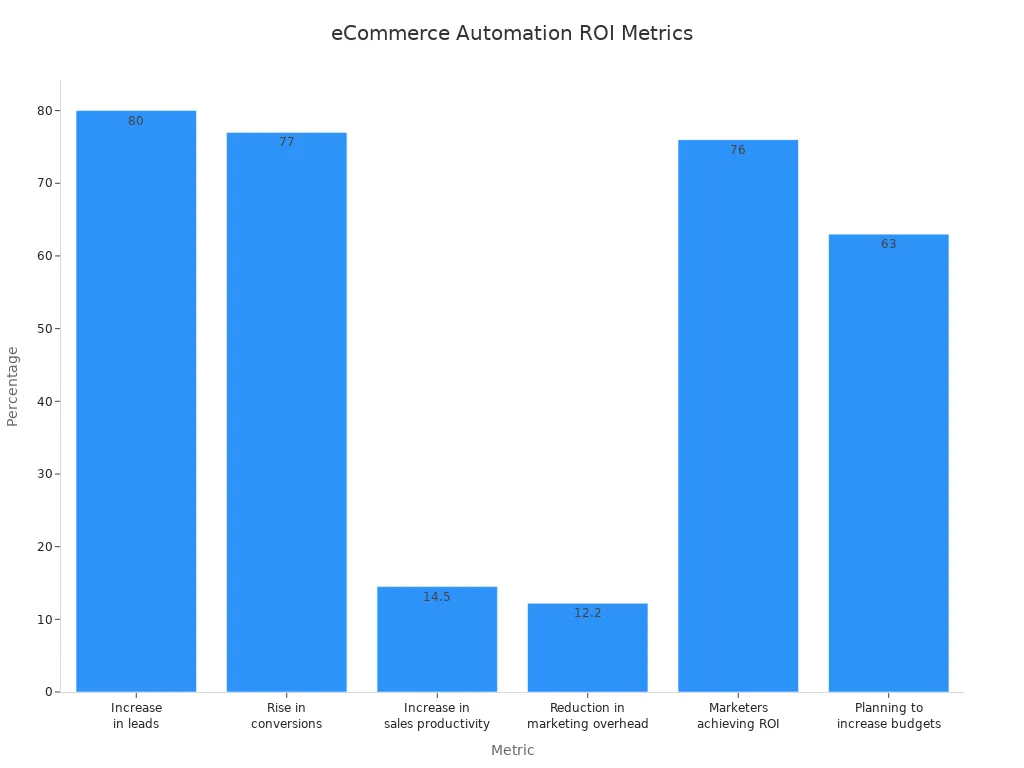
The chart above shows that order automation can increase leads by 80%, raise conversions by 77%, and improve sales productivity by 14.5%. These gains help you reach a positive roi faster.
Tracking Performance and Results
After you launch order automation, you need to track your results. Start by comparing your new numbers to your baseline. Look at your KPIs every month to see progress. Focus on real improvements, not just numbers that look good.
Here are some ways to track performance:
- Measure customer satisfaction scores. Make sure automation does not hurt your relationships.
- Track first response times. See if automated replies are faster.
- Check resolution rates for different types of questions.
- Watch abandoned cart recovery rates. See if more customers finish their purchases.
- Monitor escalation rates. Make sure customers get human help when needed.
You can also use regular surveys to see how customers and employees feel about order automation. Happy employees lead to better results. Studies show that 80% of employees feel more satisfied after automation, and businesses can see up to 200% roi in the first year.
Note: Compare your cost to serve before and after order automation. This helps you see the true value and savings from your investment.
Keep tracking your metrics for at least twelve months. You may see neutral or negative roi in the first three months. Most companies break even by month six and see strong roi by the end of the year.
Presenting and Sustaining ROI Results
Showing Short-Term and Long-Term Value
You can show the value of ecommerce automation by highlighting both quick wins and lasting benefits. In the short term, you may see operational costs drop by 20–30%. Automated cart recovery emails help you track recovered revenue. Integrating ERP systems reduces fulfillment time and costs. You also save staff time by eliminating duplicative tasks. Order processing, inventory updates, and customer notifications become faster. You serve more customers without hiring more people. Over time, you build stronger customer satisfaction and improve the customer journey. Marketing automation helps you reach customers at the right moment, leading to higher sales and loyalty.
Addressing Measurement Challenges
Measuring roi can be tricky. You may struggle to track customer behavior across platforms. Sometimes, data is inaccurate or incomplete. Technology helps, but you need to use strategic thinking. Automation tools may miss outside factors that affect your business. You must collect reliable data and analyze all relevant points. Human judgment plays a key role in interpreting results. Your goal is to improve visibility and reduce waste, not to achieve perfect accuracy.
Framework for Ongoing ROI Tracking
You need a strong framework to track roi over time. Start with a pilot phase to test your model. Expand and scale as you see positive results. Review key metrics often. Use this table to guide your tracking:
| KPI Category | Key Metrics | Review Cadence |
|---|---|---|
| Efficiency | Cycle time, throughput, hours saved | Weekly (first 90 days), Monthly |
| Quality | Error rate, exception rate, SLA compliance | Weekly, Monthly |
| Financial | Cost per transaction, cumulative ROI | Monthly, Quarterly |
| Adoption | Automation usage rate, exception override rate | Weekly, Monthly |
| Strategic | Automation coverage %, scalability achieved | Quarterly |
You can use tools like Looker Studio, Microsoft Power BI, and DashThis to visualize your results. These tools help you create clear reports for stakeholders.
Tips for Convincing Stakeholders
You can convince stakeholders by showing clear data and using regular reviews. Review operational metrics daily, performance metrics weekly, and strategic metrics monthly. Adjust your strategies based on trends. Set new targets as your business grows. Focus on customer satisfaction and the customer journey. Marketing automation helps you personalize communication and build trust. When you present both short-term gains and long-term growth, you make a strong case for continued investment in ecommerce automation.
You can prove the ROI of eCommerce automation by following a clear process. Start with baseline data and track key metrics. Use real outcomes to show value. Good governance builds trust and transparency.
- Map campaign flows and touchpoints
- Set up attribution linking
- Automate data flows
- Build stakeholder-ready reports
Involve multiple teams and use flexible workflows. Show how your insights support business goals. Apply this framework in your organization to drive growth and stakeholder buy-in.
FAQ
How long does it take to see ROI from eCommerce automation?
You can often see positive ROI within three to six months. Some businesses report results in as little as one month.
Tip: Track your metrics monthly to spot early wins.
What are the most important metrics to measure ROI?
Focus on these key metrics:
- Conversion rate
- Average order value
- Error rate
- Cost per transaction
Can automation improve customer satisfaction?
Yes. Automation speeds up order processing and reduces mistakes. Customers get faster service and more accurate updates.
Happy customers often return and buy more.
How do I present ROI results to stakeholders?
Use clear visuals like charts or tables. Show before-and-after numbers.
| Metric | Before | After |
|---|---|---|
| Order Errors | 5% | 1.5% |
| Processing Time | 2 hrs | 30 min |
See Also
Effective E-Commerce Strategies for 2025: A Practical Guide
Top 10 E-Commerce Solutions for Seamless Accounting Integration
Enhancing E-Commerce Performance with TAGG Logistics in 2025
Optimizing Warehouse Operations with Intelligent E-Commerce Techniques