

You see how closed-loop business systems use ai to optimize your daily operations. Continuous feedback lets you adjust quickly and control your data with confidence. Recent studies show that ai delivers practical, measurable improvements. For example, filtration time drops by 5.3%, recovery yield rises by 2.94%, and energy savings reach 20,150 kWh each year. These systems adapt to your needs and help you maintain product quality.
| Metric | AI-Powered Systems | Traditional Methods | Improvement (%) |
|---|---|---|---|
| Operational Efficiency | World-class levels | Below world-class | Significant |
| Energy Consumption | Reduced demand | Higher demand | Measurable |
| Yield | Increased | Standard | Notable |
| Maintenance Costs | Decreased | Higher | Substantial |
Think about the process challenges you face and how ai can help you solve them.
How AI Powers Closed-Loop Business Systems

Core Principles: Observe, Decide, Act, Learn
You can optimize your business with a closed-loop system that uses ai to drive every step. The core principle follows a cycle: observe, decide, act, and learn. This process helps you respond quickly to changes and improve your results. The OODA Loop, developed by John Boyd, shows how you can make decisions faster than competitors. You observe what is happening, decide what to do, act on your decision, and learn from the outcome. This cycle repeats, letting you adapt and stay ahead.
Ai makes this feedback loop stronger. You use prediction and action to guide your choices. You capture outcomes and link them to your original predictions. Ai learns from new data and improves weekly instead of yearly. You see models adapt to changes in seasons, markets, or user behavior. Human feedback shapes ai, making it more useful for your needs. Ai detects bias and learns from mistakes, so your closed-loop solutions become more accurate over time.
Tip: Faster improvement cycles mean you can adjust your business strategy quickly and stay resilient.
| Mechanism/Benefit | Description |
|---|---|
| Prediction and Action | The model makes a prediction or suggestion, which is then acted upon by a human or system. |
| Outcome Capture | The result of the action is captured and linked back to the original prediction. |
| Continuous Learning | The data is used to retrain or fine-tune the model, enabling ongoing adaptation. |
| Faster Improvement Cycles | Models improve weekly, not yearly, due to continuous feedback. |
| Contextual Adaptation | Models adjust to changes in seasons, markets, or user behavior. |
| Human-AI Symbiosis | Human feedback shapes the AI, enhancing its utility. |
| Bias Detection | Feedback helps identify blind spots, such as demographic biases. |
| Operational Resilience | The system learns from mistakes, improving its accuracy over time. |
You see closed-loop business systems in many industries. Ai initiatives help healthcare improve patient outcomes and efficiency. Financial services use ai for risk management and real-time analysis. Media and communications streamline content creation and boost engagement. Manufacturing uses ai to optimize production and reduce waste. Education benefits from ai by personalizing learning and improving administration.
Data Control and Security Benefits
You gain better control over your data with closed-loop solutions powered by ai. Ai interprets your goals and clarifies what success looks like. It gathers the latest data, so your decisions are always based on facts. Ai organizes your goals into steps and adapts plans as needed. It executes actions safely across different systems. You capture results and verify outcomes, then use feedback to improve future cycles.
Closed-loop solutions help you protect your business from security risks. Ai mitigates threats like adversarial machine learning attacks, data poisoning, prompt injection in large language models, and supply chain attacks. You keep your data safe and maintain trust with your customers.
Note: Ai-powered closed-loop systems automate retraining pipelines and track model versions. You always know which model made each prediction and what happened as a result.
You see the benefits of closed-loop business systems when you use ai to manage your data and security. You control your information, reduce risks, and improve your business performance.
Closed-Loop vs. Traditional Business Systems
Feedback Loops and Continuous Improvement
You can see a big difference between closed-loop business systems and traditional methods when you look at how they handle feedback. In a closed-loop system, ai creates a feedback loop that never stops learning. You give feedback, and the system uses it to improve right away. This means you get better results each time you use the system. Traditional systems often wait for problems before making changes. They use static adjustments and do not learn from every action.
Here is a table that shows how ai feedback loops compare to traditional feedback mechanisms:
| Aspect | AI Systems with Feedback Loops | Traditional Feedback Mechanisms |
|---|---|---|
| Responsiveness | High | Low |
| Adaptability | Continuous learning | Static adjustments |
| User Trust | Increases over time | May decrease due to errors |
| Improvement Opportunities | Constantly identified | Often missed |
You notice that ai systems learn from both human and system feedback. They adapt to new user behavior and changing data patterns. This leads to ongoing improvements in accuracy and relevance. You can trust that closed-loop solutions will keep getting better as you use them.
Operational Efficiency and Adaptability
You want your business to run smoothly and adapt to change. Closed-loop solutions help you reach these goals. Ai gives you tools to make quick decisions and adjust your operations. You see gains in efficiency, cost savings, and better decision-making.
Here is a table that highlights the benefits you get from ai in closed-loop systems:
| Evidence Type | Description |
|---|---|
| Efficiency Gains | AI integration has led to increased efficiency in supply chain operations, enhancing adaptability and competitiveness. |
| Cost Reduction | AI technologies have contributed to significant cost savings through optimized inventory management and reduced waste. |
| Improved Decision-Making | AI applications provide precise demand forecasting and greater visibility, leading to better operational decisions. |
You see that closed-loop business systems give you a clear advantage. Ai helps you spot problems early and fix them before they grow. You can change your strategy quickly and stay ahead of your competition. A closed-loop system gives you the power to keep your business strong in a fast-changing world.
Benefits of AI Closed-Loop Business Systems
Measurable Results and Performance Gains
You see real improvements when you use closed-loop solutions powered by ai. These systems help you track performance and measure gains across your business. You can reduce downtime, lower costs, and improve safety. Ai helps you automate tasks and optimize your supply chain. You notice faster processing times and fewer errors. Closed-loop business systems give you clear results that you can measure.
| AI Application | Measurable Results |
|---|---|
| Predictive Maintenance | Reduced unplanned downtime, lower labor costs, improved safety, ROI in 6 to 18 months. |
| IT Operations | Labor cost reductions, faster incident resolution, optimized infrastructure costs. |
| Document Automation | Lower costs per invoice, shorter processing times, reduced error rates, saved full-time equivalent hours. |
| Supply Chain Optimization | Reduced inventory carrying costs, fewer stockouts, improved service levels. |
| Customer Experience Enhancement | Lower support costs, faster issue resolution, reduced customer churn. |
Tip: You can use a feedback loop to keep improving your results and reach new performance goals.
Enhanced Decision-Making and Productivity
Ai gives you tools to make better decisions and boost productivity. Closed-loop solutions use predictive models to analyze large datasets. You get recommendations that help you choose the best path for your business. Ai can process information faster than humans and reveal hidden options. You see new ways to solve problems and adapt quickly.
| Evidence Description | Key Insights |
|---|---|
| AI's predictive models analyze vast datasets | AI can identify patterns and provide actionable recommendations, enhancing decision-making across various business areas like sales and strategy. |
| AI's ability to process large amounts of data | AI can make optimal decisions much faster than humans, which is crucial for future advancements in various fields. |
| Generative AI and predictive systems | These systems can reveal hidden options and suggest innovative pathways, improving decision-making speed and adaptability. |
| AI tools utilize unstructured information in real-time | This capability allows organizations to analyze metrics beyond traditional methods, leading to more informed decisions. |
You notice that closed-loop systems help you work faster and smarter. Support agents handle more customer inquiries per hour. Business professionals write more documents. Programmers finish more projects each week. On average, ai tools increase productivity by 66%.
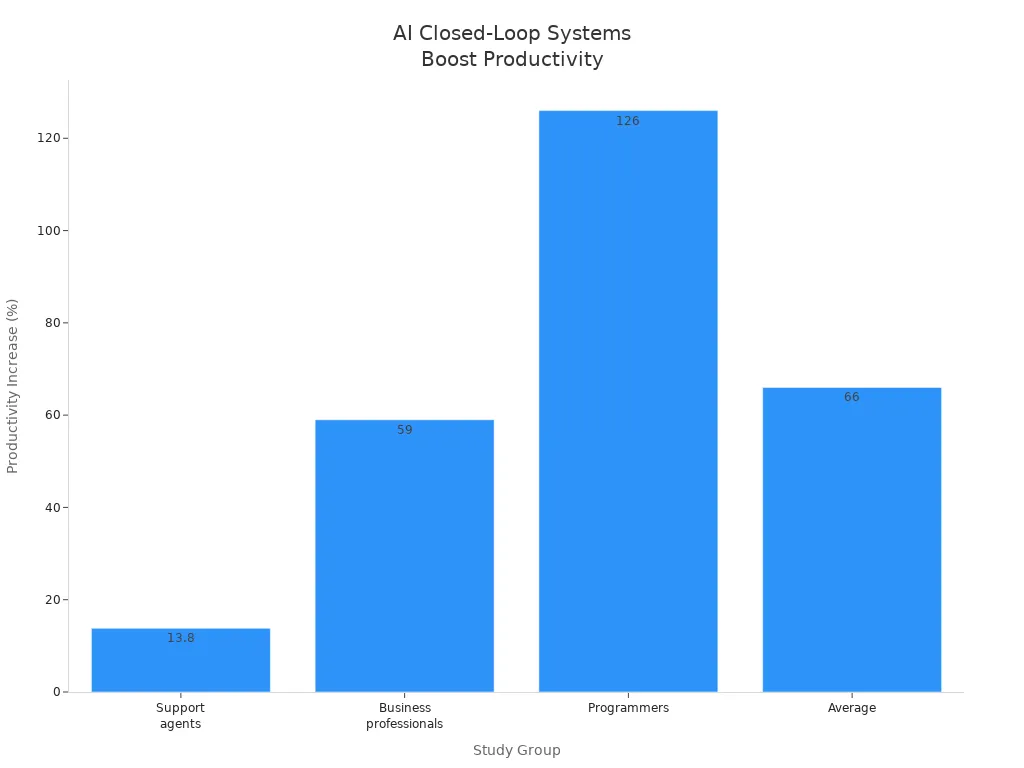
Note: You can use a closed-loop system to keep your business strong and productive. Ai helps you make decisions with confidence and reach your goals faster.
Real-World Applications of Closed-Loop AI

IT and Cloud Automation
You can transform your IT operations with closed-loop business systems. These systems use ai to replace rigid workflows with adaptive feedback loops. You see operational efficiency improve as the system observes and acts on telemetry data. This process ensures your data stays reliable and up to date. When your network faces peak loads or sudden changes, closed-loop solutions reduce mean time to recovery. You restore services faster and keep users happy.
- You benefit from predictive analytics and machine learning that detect anomalies.
- The system auto-remediates failures, which boosts operational resilience.
- You receive trustworthy data through resilient APIs and event streaming.
Tip: Real-time feedback helps you spot issues early and keep your systems running smoothly.
Healthcare Process Optimization
You can use ai initiatives to improve healthcare processes. Closed-loop solutions give you recommendations for sourcing strategies based on supplier performance and risk. You match equipment supply with demand, which helps you schedule diagnostic and treatment equipment more efficiently. The system updates surgery preference cards automatically by learning from past usage patterns. This ensures you always have the right supplies ready.
Integrating Quality Management System principles into ai technologies helps you optimize processes. You create a strong framework that supports compliance and reduces redundancy. This approach leads to better clinical workflows and improved patient outcomes.
Note: Closed-loop learning systems in healthcare support safe and ethical deployment of ai, which benefits both staff and patients.
Manufacturing and Supply Chain
You can see the impact of ai in manufacturing and supply chain management. Companies that use a closed-loop system report higher efficiency and lower costs. You find that data analytics and closed-loop solutions help you reduce waste and increase productivity.
| Source | Evidence | Impact |
|---|---|---|
| McKinsey & Company | Closed-loop systems in manufacturing | 20% increase in efficiency |
| Toyota | Production system | 30% reduction in waste |
| Gartner | Integrated closed systems | 15% reduction in costs |
| McKinsey | AI-driven technologies in manufacturing | 10–30% increase in throughput |
| McKinsey | AI-driven technologies in manufacturing | 15–30% gains in productivity |
| McKinsey | AI-driven technologies in manufacturing | 30–50% less unplanned downtime |
You use a feedback loop to adapt quickly to market changes. Closed-loop business systems give you the tools to stay competitive and resilient.
Implementing AI Closed-Loop Systems
Setting Goals and KPIs
You start by setting clear goals for your AI project. Align your efforts with your company’s main priorities. Make sure your goals support your business strategy. Create specific, measurable, and time-bound KPIs. These KPIs should connect directly to your business objectives. Companies that set new KPIs for AI see better results. In fact, only about one-third of managers create new KPIs, but most who do report improved outcomes. Build a roadmap that includes both technical metrics, like model accuracy, and business outcomes, such as cost savings or customer satisfaction.
- Align AI projects with business priorities
- Set measurable, time-bound KPIs
- Include both technical and business metrics in your roadmap
Tip: Clear KPIs help you track progress and prove the value of your AI investment.
Integrating Feedback and Analytics
You need to collect feedback and use data analytics to improve your closed-loop solutions. Start by defining what you want to achieve and how you will use feedback. Set up systems that let users share their experiences in real time. Use data analytics tools to study this feedback and measure both technical performance and user satisfaction. Compare your metrics before and after making changes. When users see their feedback leads to real improvements, they trust the system more. Begin with high-impact areas and use simple feedback tools first. Make sure teams from different departments share feedback and learn together.
- Define clear objectives for feedback
- Collect real-time feedback from users
- Use data analytics to refine your system
- Encourage teamwork and ongoing learning
Overcoming Challenges and Ensuring Scalability
You may face challenges when you set up closed-loop learning systems. Data integration can be hard because your data comes from many places. Privacy and security rules, like GDPR, require careful planning. Some AI models are hard to understand, which can be a problem in regulated industries. Bias and fairness need human oversight. Employees may worry about job changes, so clear communication helps. Ongoing education builds trust and skills.
| Challenge | Description |
|---|---|
| Data Integration | Data comes from many sources and formats |
| Privacy and Security | Rules like GDPR require strong protection |
| Algorithmic Opacity | Some AI models are hard to explain |
| Bias and Fairness | Human oversight is needed to avoid bias |
| Integration Issues | Old systems may need updates |
| Cultural Resistance | Employees may worry about job changes |
| Lack of AI Literacy | Ongoing education is important |
To scale your system, focus on strong data management and security. Set up clear rules for AI governance and transparency. Monitor your models and automate learning to keep performance high. Schedule regular reviews and retrain your models as needed. This helps your system stay accurate as your business grows.
You see how AI closed-loop business systems transform process optimization. These systems boost throughput, improve energy efficiency, and enhance safety margins. You can follow practical steps to adopt AI: set a clear strategy, build a skilled team, create a roadmap, identify areas for integration, and use an iterative approach. Assess your current systems by checking data readiness, technology, and talent. Explore resources that guide operational efficiency, legal considerations, and measurable business impact. Start your journey toward smarter, more resilient operations.
| Operational Gain | Description |
|---|---|
| Improved Throughput & Yield | AI models optimize feed rates and temperatures, leading to higher production and revenue. |
| Energy Efficiency | Continuous recalibration reduces energy use and costs, enhancing sustainability. |
| Enhanced Safety Margins | Predictive AI models prevent unsafe conditions, improving safety without additional equipment. |
FAQ
What is an AI closed-loop business system?
You use an AI closed-loop business system to collect data, make decisions, act, and learn from results. This system helps you improve your business by repeating this cycle and adapting to changes.
How does AI improve process optimization?
AI helps you spot problems early and fix them fast. You get real-time feedback and can adjust your actions. This leads to better results and less waste.
Is my data safe in a closed-loop system?
Yes, you control your data in a closed-loop system. AI tools help you protect information and track changes. You can follow security rules and keep customer trust.
Can small businesses use AI closed-loop systems?
You can use AI closed-loop systems even if you run a small business. Many tools offer easy setup and support. You start small and grow as you see results.
See Also
Utilizing AI to Improve Production Forecasting Accuracy in 2024
Capacity Planning for Brands Enhanced by AI Technology
Accelerating Market Entry: AI's Role in Reducing Lead Times
AI-Powered Production Scheduling Based on Demand in 2025
AI Solutions for Dynamic Safety Stock in Fashion Retail 2025