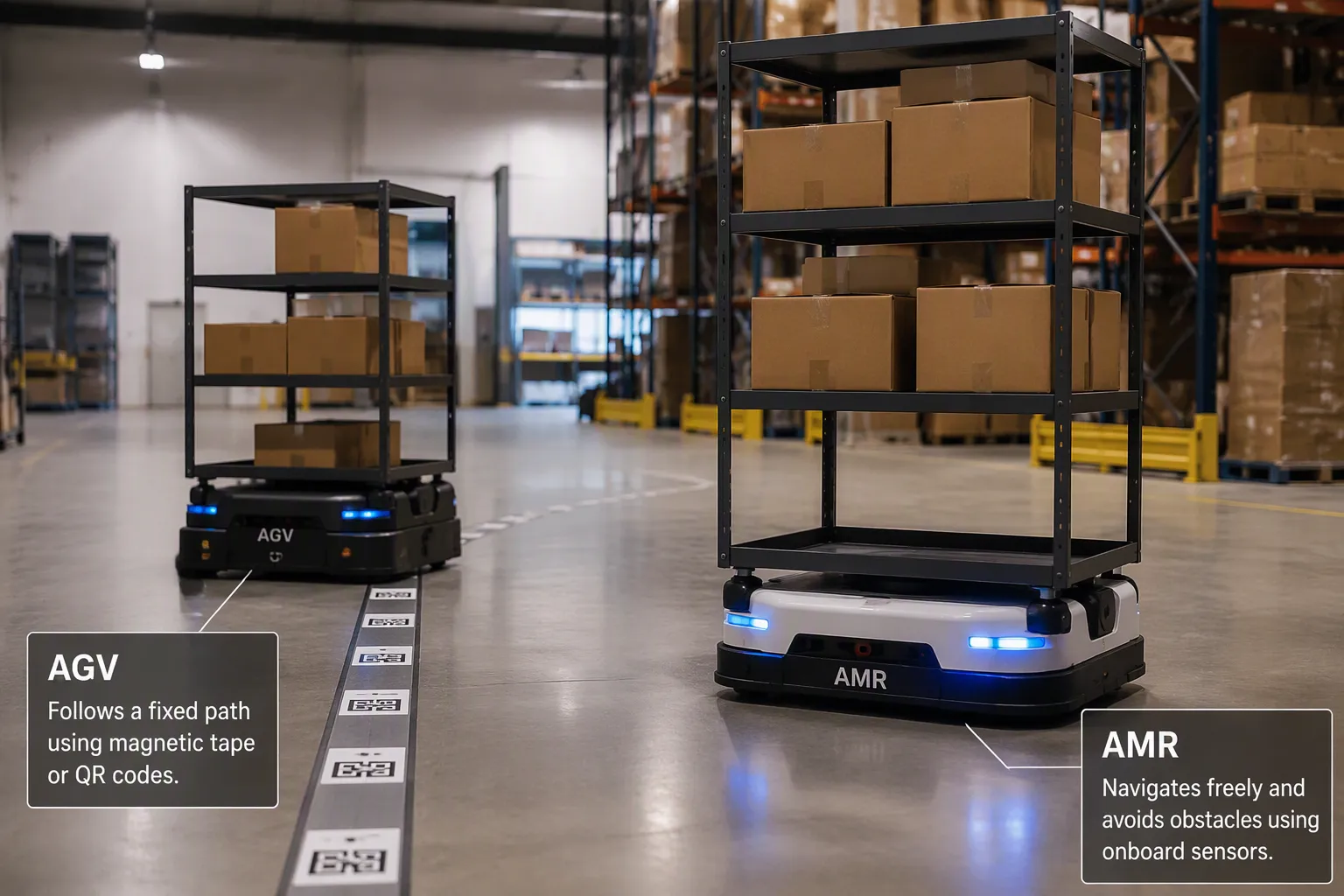
An Automated Guided Vehicle (AGV) follows a fixed path marked by wires, tapes, or magnets. An Autonomous Mobile Robot (AMR) navigates autonomously using onboard sensors and real-time mapping. The decision between AGVs and AMRs depends on warehouse dynamics, payload, and scalability. For teams choosing warehouse robots, these factors determine the optimal technology. AMRs offer flexibility, while guided vehicles provide consistency for high-volume flows. AMRs adapt to layout changes, making them ideal for flexible facilities. Both types serve specific needs in warehouse automation.
According to Spherical Insights & Consulting, the global Automated Guided Vehicle market was valued at USD 4.88 billion in 2024.
This article examines both robot types—AGVs and AMRs—and compares navigation, flexibility, and cost. A decision framework helps evaluate AMRs vs AGVs. Key factors like payload and precision docking shape warehouse automation.
Automated Guided Vehicles Defined
Automated guided vehicles are transport robots that move along predetermined routes. These machines carry goods from one point to another without a human driver. AGVs rely on external guidance systems installed in the floor or along the ceiling. This design makes AGVs predictable and repeatable for high-volume tasks.
How AGVs Navigate Fixed Paths
AGVs follow fixed paths using physical or magnetic markers. Common navigation mechanisms include magnetic tape, buried wire, and magnetic grid spots. A magnetic tape route sits on the floor surface. A buried wire runs beneath the concrete. Magnetic spots guide AGVs through precise turns and stops. Each method requires a predefined route before operation begins.
The vehicle reads these markers through onboard sensors and adjusts its steering to stay on course. AGVs do not calculate new routes on their own. They stop when an obstacle blocks the path. This behavior keeps AGVs reliable in structured settings. The benefits of using AGV systems include consistent cycle times and minimal route deviation. AGVs handle larger loads than many other mobile robots. They also cost less per unit when the layout stays stable.
When to Choose AGVs for Stable Environments
AGVs suit warehouses with predictable, high-volume flows. A facility that moves the same pallets along the same aisles every day gains little from dynamic navigation. AGVs excel in these stable environments. They move heavy loads across long distances with minimal downtime.
Installation takes longer for AGVs than for other robot types. Teams must lay tape, cut concrete for wires, or mount magnetic markers. This upfront work pays off in stable layouts. The cost per AGV drops when a facility deploys many units on the same routes. Integration with existing conveyor systems and warehouse controls also becomes simpler over time. The benefits of using AGV fleets grow as volume rises and the layout stays fixed. An AGV strategy fits operations that value consistency over adaptability.
Autonomous Mobile Robots Explained
Autonomous mobile robots navigate without fixed paths. These machines use onboard sensors to build maps and plan routes in real time. An AMR moves through busy aisles, avoids people, and recalculates its path within seconds. An AMR navigates around moving forklifts and unexpected obstructions. This freedom separates AMRs from guided vehicles.
How AMRs Navigate Dynamically
LiDAR serves as the primary perception sensor for most commercial AMRs. It emits laser pulses to measure distances and generates a 360-degree point cloud map updated dozens of times per second. LiDAR provides millimeter-level accuracy over ranges of 30 meters or more. It performs consistently regardless of lighting conditions.
SLAM lets robots build facility maps while tracking position with millimeter precision. The technology enables real-time localization by comparing new sensor data with previously collected information. AMRs stop or reroute when they detect an obstacle. Multi-sensor fusion combines LiDAR, 3D depth cameras, and proximity sensors. Dynamic path planning recalculates routes in real time and optimizes paths multiple times per second. Loop closure corrects accumulated localization errors when the robot revisits a mapped area.
When to Choose AMRs for Flexible Layouts
AMRs excel in order picking, replenishment, and rapid change. These robots adapt to new layouts without floor modifications. An AMR can still perform precision docking with advanced sensors. Teams use AMRs for picking tasks across many zones. Picking routes change often in dynamic facilities. AMRs handle picking workflows with ease. Picking accuracy improves with real-time mapping. Picking speed rises when robots avoid congestion. Picking stations receive goods without fixed conveyors. Picking operations scale up or down as demand shifts. Picking teams work alongside AMRs safely. Each AMR supports warehouse picking goals. An AMR fleet grows one unit at a time.
AMR automation enables businesses in various industries to stay agile and optimize production, even in highly dynamic environments.
Manufacturing, logistics, healthcare, and agriculture all benefit. AMRs deploy in days without fixed infrastructure. Teams redeploy them across zones with ease. This integration supports incremental scalability and lower upfront investment.
Compare AGVs and AMRs
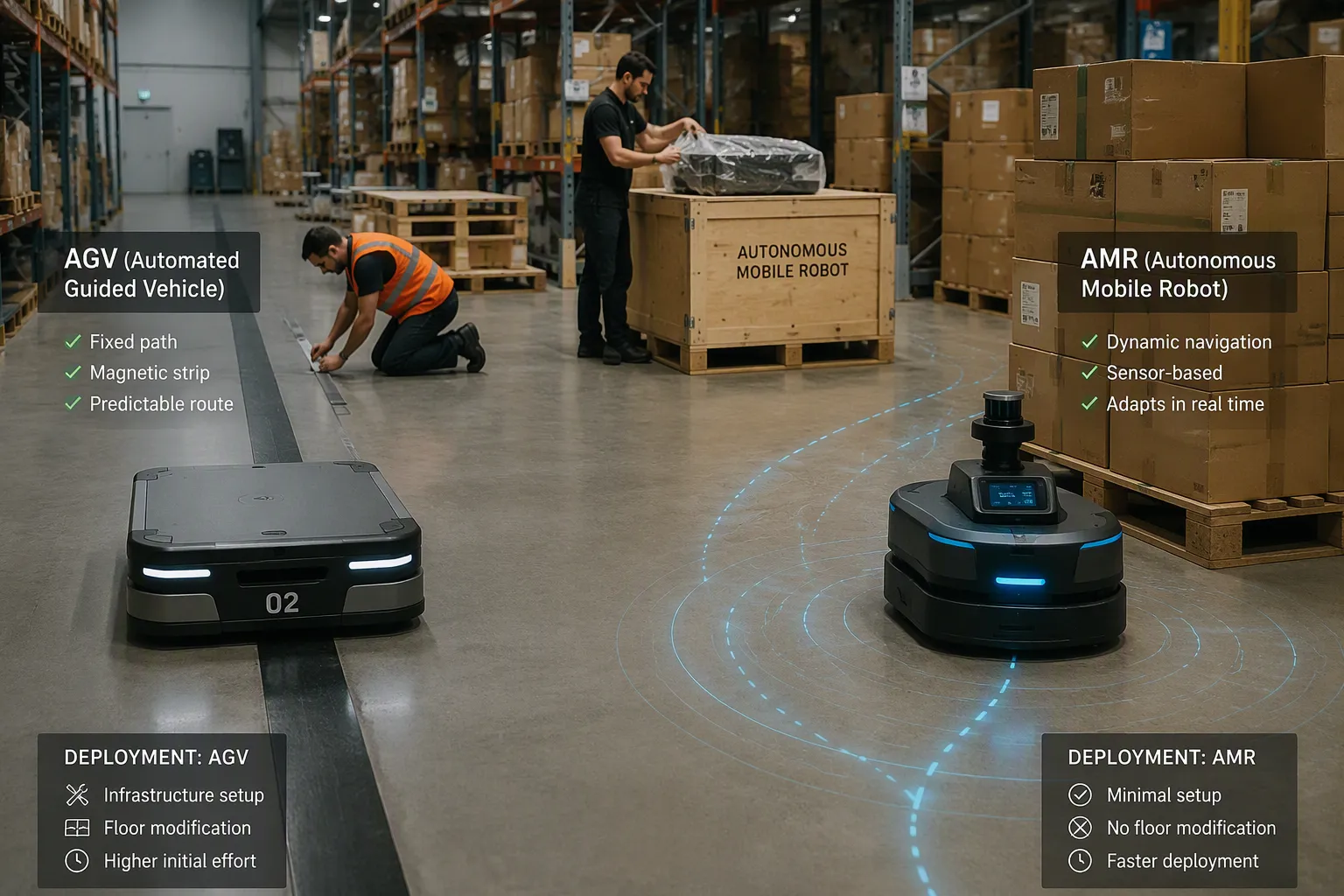
Choosing between AGVs and AMRs requires examining six key axes. This section compares AGVs and AMRs across navigation, flexibility, deployment speed, cost, payload, and scalability. The goal presents trade-offs without declaring a winner. Operations managers match facts to their warehouse conditions.
Navigation, Flexibility, and Deployment Speed
The most fundamental difference exists between AGVs and AMRs. AGVs follow predefined physical guides such as wires or magnetic strips. AMRs use sensors, cameras, LiDAR, and VSLAM to map and navigate independently. This difference drives all other comparisons.
| Performance factor | Fixed-path navigation | Dynamic navigation |
|---|---|---|
| Navigation method | Predefined guides such as wires or magnetic strips | Sensors, cameras, LiDAR, and VSLAM |
| Route flexibility | Limited to fixed paths; infrastructure changes needed | Dynamically plans routes; adapts to layout changes |
| Obstacle response | Stops when encountering an obstacle | Detects and avoids obstacles; continues tasks |
| Real-time responsiveness | Cannot react to changes in real time | Adapts and reroutes in real time |
| Travel-time implication | Predictable in controlled environments | More consistent in dynamic environments |
| Rerouting implication | Depends on human intervention | Performed dynamically and in real time |
AGVs rely on fixed routes. AMRs create maps and reroute on the fly. AGVs need infrastructure changes for new tasks. AMRs use AI and sensor fusion for dynamic navigation. AMRs stop and recalculate routes when humans cross their path. This capability keeps material flowing even in congested aisles.
Deployment speed differs significantly. AGVs require weeks for installation. Teams must lay tape or mount markers across the facility. AMRs deploy in days. No floor modifications are needed. A facility can unbox an AMR, drive it through the space once to build a map, and put it to work. This speed advantage proves critical for seasonal operations.
Cost, Payload, and Scalability Trade-Offs
Cost structures differ between AGVs and AMRs. AGVs have lower upfront costs per unit. The hardware relies on external markers rather than expensive onboard sensors. Installation costs add up though. The total investment includes floor modifications, tape or wire materials, and labor. AMRs carry a higher per-unit price. The onboard sensor suite raises the hardware cost. But AMRs require no infrastructure investment. For a single robot, an AGV strategy may appear cheaper. For a growing fleet, AMRs deliver lower total cost over time.
Payload capacity represents another key differentiator.
| Robot Type | Maximum Carrying Capacity | Maximum Towing Capacity |
|---|---|---|
| AMR | up to 3,300 lbs | over 10,000 lbs |
| AGV | over 11,000 lbs | over 100,000 lbs |
An AGV handles substantially heavier loads. Facilities moving large pallets need an AGV system. An AMR carries up to 3,300 pounds and tows over 10,000 pounds. This range covers many picking and transport applications. Operations managers measure their heaviest typical load before choosing an AGV or an AMR. An AGV fits bulk transport. An AMR suits most order fulfillment tasks.
Scalability follows a similar pattern. AGVs scale in batches. Adding AGVs to fixed routes is straightforward. Changing route infrastructure costs time and money. AMRs scale one unit at a time. A facility adds an AMR without floor modifications. A facility adds an AGV when routes remain stable. The integration with warehouse management systems happens wirelessly for both types. This incremental scalability suits variable demand. Redeploying these robots across warehouse zones improves flexibility. A hybrid approach using both types serves large facilities. The right robots depend on each robot application's unique needs.
Framework for Choosing Warehouse Robots
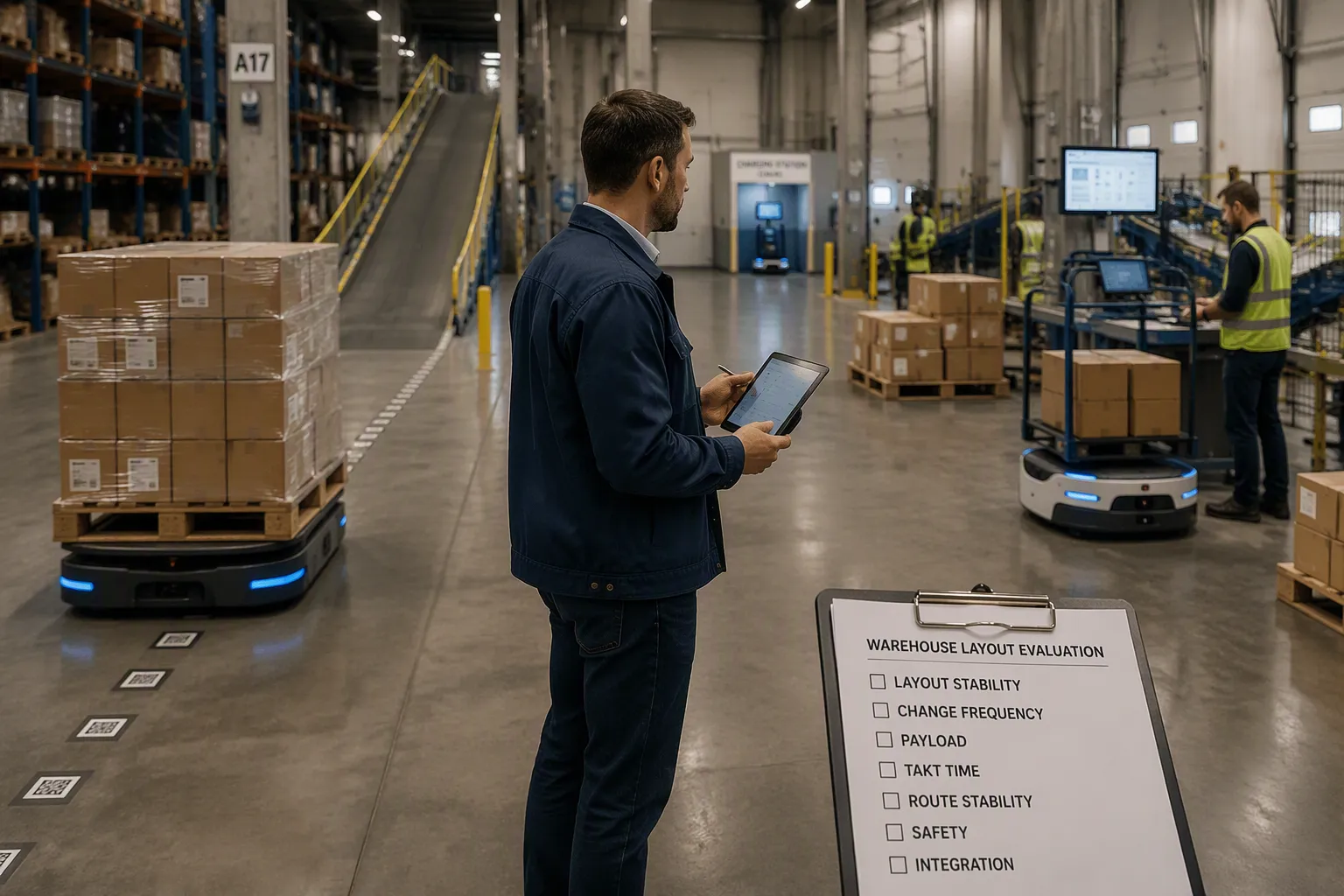
Every warehouse operator needs a systematic method for choosing warehouse robots. The decision depends on three core variables: layout stability, change frequency, and payload requirements. Logistics consultants recommend treating the selection as a spectrum rather than a binary choice. The navigation and autonomy spectrum ranges from fixed-path systems to fully dynamic platforms. A facility identifies its position by examining payload, takt time, route stability, safety case, and integration needs. Stable, heavy, high-precision work points toward AGVs. Fluid, fast-changing flow points toward AMRs. The operator lets the system design drive the label rather than forcing a predetermined technology.
Assessing Layout Stability and Change Frequency
The first question examines whether routes remain fixed or shift over time. A warehouse manager walks proposed routes during normal operations and observes congestion around packing stations, temporary pallets, open dock doors, and pedestrian shortcuts. The manager examines the physical journey. Is the route repetitive and predictable or does it change throughout the day? Are there narrow aisles, steep thresholds, ramps, or mixed pedestrian traffic? These observations reveal whether an environment suits fixed-path machines or flexible platforms. The charging strategy matters too. Can the robot charge during natural downtime? Does it need dedicated charging areas? How does battery availability align with shift schedules?
Change frequency drives the second major assessment. Facilities that reconfigure lines, SKUs, or layouts often need adaptable solutions. High change frequency favors AMRs because they reduce downtime and rework. AMRs handle multi-SKU, fast-changing environments with ease. AMRs adapt to frequently changing product mixes or warehouse layouts without floor modifications. AMRs excel when product velocity shifts rapidly. Stable environments with high-volume flows point toward AGVs. A mass-production factory with minimal layout changes benefits from the lower upfront cost of guided vehicles. An e-commerce fulfillment center selects AMRs. The process determines the technology.
Evaluating Total Cost of Ownership over Time
Total cost of ownership extends far beyond the purchase price. Installation costs differ significantly. AGVs require floor modifications including tape laying or wire burial. AMRs require no infrastructure changes. Reconfiguration costs matter when layouts change. Every route modification for an AGV requires physical infrastructure work. AMRs accept new maps wirelessly with no floor work.
Energy consumption profiles affect long-term operating costs. AMRs consume power only during active operation. Traditional systems often require continuous energy input for guidance infrastructure. These differences compound over years of operation. Maintenance differs as well. Guided vehicles rely on physical markers that wear or get damaged. AMRs depend on onboard sensors requiring periodic calibration. The framework for choosing warehouse robots must account for these ongoing expenses.
Best practices for warehouse automation include running a pilot program before scaling. Start with a pilot run and test at a lower scale. This approach identifies structural problems, network blind spots, and operational frictions. The team evaluates performance, gathers insights, and makes adjustments. Simulation models throughput before full rollout. Employees train alongside the robots during the pilot phase. Human-robot collaboration requires practice.
Interoperability standards such as VDA 5050 make the decision increasingly reversible. This standard allows mixed-brand AGV and AMR fleets managed by a single fleet manager. A facility can start with one technology and add the other later. The surrounding system design drives the label. System integration becomes simpler with standard interfaces.
Key Factors: Payload and Precision Docking
Matching Payload to Robot Capabilities
Payload capacity separates AGVs and AMRs more sharply than any other specification. AGVs transport very large loads that exceed the limits of most mobile platforms. AMRs carry lower payloads, yet their capacity still covers a wide range of warehouse tasks. Operations managers should measure their heaviest typical load before selecting a robot type. This single measurement eliminates unsuitable options immediately.
An AGV handles bulk transport of heavy pallets and industrial containers. An AMR manages most order fulfillment and replenishment duties within its rated capacity. Teams that move oversized machinery or dense raw materials lean toward AGVs. Teams that move totes, cartons, and light assemblies find AMRs sufficient. The payload decision often determines the entire robot strategy before other factors enter the discussion.
Precision Docking: AGVs and AMRs Compared
A common assumption holds that only AGVs achieve tight docking tolerances. Modern AMRs challenge this belief through advanced sensor fusion and real-time correction. Specialized alignment systems achieve tight docking tolerances using alignment guides, automated positioning mechanisms, and real-time adjustment capabilities. These systems minimize positioning errors and enable efficient cargo transfer through accurate spatial coordination and automated correction mechanisms.
| Industry | Precision Requirement | Supporting Detail |
|---|---|---|
| Pharmaceutical and healthcare logistics | High precision | Medical supplies, diagnostic samples, and pharmaceuticals require exceptional handling accuracy for damage prevention and regulatory compliance |
| Electronics assembly and manufacturing | Tight tolerances | Just-in-time inventory systems need precise tracking and positioning of small components |
| E-commerce and warehouse logistics | Precise positioning | AI-powered vision and SLAM navigation enable precise object recognition for fragile items, with high picking accuracy |
Collaborative robots with advanced vision and force-torque sensors achieve high positioning accuracy in controlled settings. Modern AMR systems achieve high positioning accuracy using SLAM navigation and multi-sensor fusion. These capabilities surprise decision-makers who associate dynamic navigation with loose positioning. The relevant safety standard defines the difference between AGVs and AMRs based on how they traverse the operating environment.
AGVs typically follow simpler and clearer tasks and routes than AMRs, which contributes to their dependability and safety.
AGVs follow predefined guide paths and use collision avoidance by stopping and waiting when blocked. AMRs detect obstacles with sensors and compute an obstacle-free path through free space. This distinction shapes how each robot type approaches a docking station. Both technologies now deliver the precision that high-value material handling demands.
The decision between AGVs and AMRs is not binary. It is a spectrum. Many warehouses benefit from a hybrid approach. Stable, high-volume, large-payload routes favor AGVs. Dynamic, flexible, scalable operations favor AMRs. Teams choosing warehouse robots should think system-level. They run a pilot with a small fleet. They use simulation to model throughput before a full rollout. This approach reduces risk and validates integration early. Teams choosing warehouse robots gain confidence through testing. AMRs handle change well. AMRs scale easily. AMRs support hybrid fleets. AMRs complement AGVs in mixed layouts. AMRs deliver long-term value. List your top three material flows, note the payload and layout stability of each, and match them to the robot strategy that fits.
FAQ
Can a facility run AGVs and AMRs together?
Yes. Interoperability standards such as VDA 5050 allow mixed-brand fleets managed by a single fleet manager. A warehouse can start with one technology and add the other later. This integration makes the decision increasingly reversible.
How long does deployment take for each robot type?
AGVs require weeks for installation because teams must lay tape or mount markers. AMRs deploy in days with no floor modifications. A facility can unbox an AMR, drive it through the space once to build a map, and put it to work.
Do AMRs sacrifice docking precision for flexibility?
No. Modern AMRs achieve tight docking tolerances through advanced sensor fusion and real-time correction. Modern AMR systems achieve high positioning accuracy using SLAM navigation. Collaborative robots with advanced vision and force-torque sensors achieve high positioning accuracy in controlled settings.
What safety standard defines the difference between AGVs and AMRs?
The relevant safety standard defines the difference based on how each robot traverses the operating environment. AGVs follow predefined guide paths and stop when blocked. AMRs detect obstacles with sensors and compute an obstacle-free path through free space.
Which robot type scales more easily for growing operations?
AMRs scale one unit at a time without floor modifications. AGVs scale in batches and require route infrastructure changes. Incremental scalability suits variable demand. A hybrid approach using both types serves large facilities with diverse material flows.
See Also
Using Artificial Intelligence To Improve Production Forecasting Accuracy In 2024 Enterprises
Achieving Maximum Efficiency Through Intelligent Ecommerce Warehouse Management Strategies
Artificial Intelligence Powered Capacity Planning Solutions For Modern Brands
Demand Based Artificial Intelligence Production Scheduling Strategies For 2025
Artificial Intelligence Routing Algorithms Reduce Fashion Delivery Times By Twenty Two Percent